

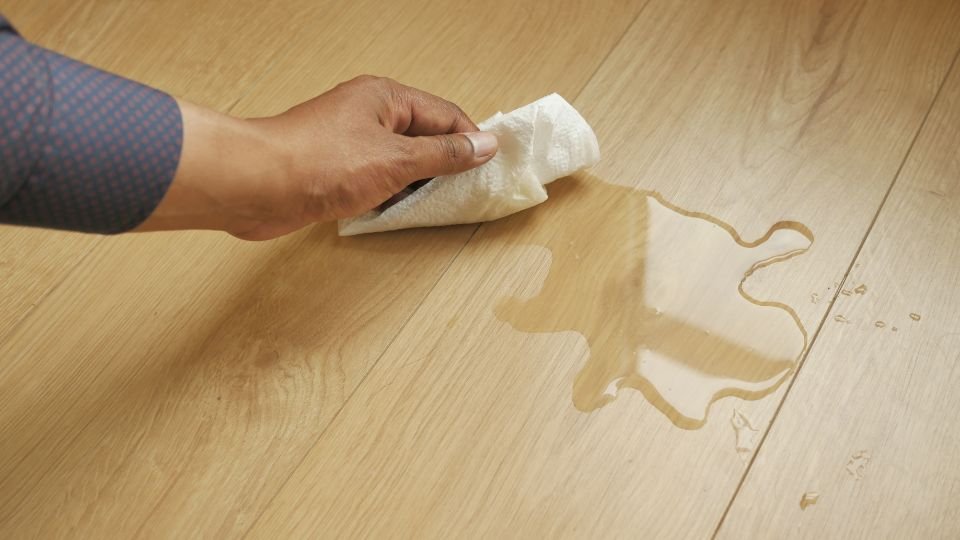
Moisture performance specifications surface consistently in residential and light commercial flooring projects, above all in zones exposed to spills, tracked moisture, or shifting humidity conditions. Traditional laminate flooring is not waterproof. It provides tiered water resistance determined by core density, edge sealing techniques, and surface barrier effectiveness, but extended standing water exposure routinely triggers core swelling, joint separation, and permanent plank deformation. Contractors and specifiers managing kitchens, entry areas, or below-grade spaces—where occasional leaks or condensation appear—rely on precise damage progression timelines and material constraints to minimize callbacks and preserve installation integrity.
Laminate Flooring Construction and Moisture Vulnerability
Laminate planks result from layered compression under exacting heat and pressure parameters. The uppermost wear layer merges melamine resin with aluminum oxide abrasives to achieve scratch resistance and shield the underlying decorative print film. That film reproduces authentic wood grains, stone effects, or patterned visuals with precision. The core layer—predominantly high-density fiberboard—supplies structural rigidity, load distribution, and secure click-lock engagement. A stabilizing backing layer offsets internal stresses and typically features a moisture-retardant coating.
Core material controls water response. Fiberboard absorbs liquid mainly through joints or subtle surface breaches, initiating expansion. Standard 24-hour immersion tests on basic laminate frequently indicate 15% to 25% thickness gain, whereas refined formulations with compacted fiber and boosted resin levels suppress rates markedly. Advanced edge treatments and resin enrichment in select grades extend brief-exposure tolerance, though wood-derived cores fundamentally preclude true waterproof status. Field installations confirm that repeated humidity cycles impose ongoing stress on seams, incrementally widening small gaps or inducing edge lift throughout service duration.
Damage Progression: Timeline and Observable Effects
Moisture deterioration advances in a predictable sequence governed by spill volume, contact duration, environmental variables, and subfloor condition. Transient events—spilled beverages or fleeting pet incidents—pose negligible threat when resolved promptly. Wear layers combined with treated edges retain surface liquid temporarily.
Within 5 to 30 minutes, ingress proceeds along joints, especially in high-traffic paths or zones with minor plank flexure. Absorption commences subtly, occasionally signaled by faint edge cupping or modified underfoot resonance prior to distinct visual manifestation.
Over following hours, uneven swelling generates evident distortion. Inter-plank pressure builds ridges at thresholds or transitions, perimeter detachment, or buckling that detaches portions from the subfloor. Areas with persistent relative humidity exceeding 65% experience hastened progression, amplifying load on locking systems.
After 24 hours of persistent wetting, dimensional restoration becomes improbable. Warping fixes plank configuration permanently, while entrapped moisture fosters mold in concealed pockets. Subfloor staining and residual odors intensify complications, commonly requiring excision of impacted sections. Site records indicate overnight events—appliance overflows, rain-driven intrusion, or gradual seepage—cluster buckling proximate to the origin, with repair scopes expanding rapidly after identification.
Response Protocol: Handling Wet Laminate Flooring
Intervention timing dictates recovery potential. Confined spills demand immediate blotting with absorbent materials—press and lift to draw liquid out without deeper displacement. Arrange fans and dehumidifiers for consistent airflow, sustaining relative humidity below 60% during the drying interval. Localized intense heat sources risk differential contraction and warrant exclusion.
Substantial incidents—plumbing breaches, exterior ingress, or fixture failures—necessitate swift extraction employing wet-vac apparatus. Disassemble accessible sections where locking mechanisms allow, permitting thorough subfloor drying. In humid or restricted environments, mechanical drying equipment often proves indispensable to arrest advancement.
Limited swelling may partially abate with continuous drying, though residual edge rise or narrow gaps commonly endure. Irreparably distorted planks require substitution, ideally sourced from identical production batches to sustain uniformity. Warranty stipulations generally encompass incidental surface contacts but exclude prolonged submersion cases.
Prevention Strategies for Moisture-Prone Installations
Installation fundamentals underpin long-term behavior. Maintain designated expansion clearances—ordinarily 8–12 mm around perimeters, columns, and fixtures—to facilitate hygric and thermal adjustments. Utilize vapor-retardant underlayment atop concrete to interrupt ascending dampness, an element particularly relevant for export shipments encountering diverse climate regimes.
Operational and maintenance protocols extend longevity. Eliminate spills instantaneously to restrict penetration. Deploy mats at entrances, under wet-zone appliances, and around pet locations to intercept direct liquid exposure. Schedule routine joint examinations in heavy-traffic sectors to spot early gap progression. In multi-residential or scaled projects, batch uniformity—facilitated by tight core density management and precise milling—curtails performance disparities throughout the flooring expanse.
Enhanced Laminate and Rigid Alternatives
Contemporary laminate enhancements encompass denser cores, amplified resin impregnation, and sophisticated locking geometries that curtail seam vulnerability. Water-resistant grades tolerate incidental contact from 30 minutes to several hours, suiting them to dynamic kitchens or entryways where rapid response prevails.
Applications demanding uncompromising moisture resistance favor stone plastic composite (SPC) flooring. The rigid core—constituted from limestone filler and polymer stabilizers—displays negligible absorption and robust dimensional stability across extensive humidity ranges. SPC upholds click-lock installation familiarity comparable to laminate while furnishing heightened dependability in laundry facilities, powder bathrooms, and basement-level finishes.
About Shandong Lanhe Import and Export Co., Ltd.
Shandong Lanhe Import and Export Co., Ltd. specializes in laminate and SPC production with meticulous control throughout raw material intake, manufacturing, and final validation. Automated operations guarantee steady core density, surface resilience, and locking accuracy, substantiated by FloorScore, CE, and environmental certification protocols. Laminate series stress strong water resistance through refined coatings and core modifications for moderate-exposure contexts, while SPC collections supply reliable zero-absorption performance tailored to exacting specifications. Products distribute to North America, Europe, Australia, and additional territories, reinforced by systematic quality verification and climate-adapted durability testing.
Conclusion
Moisture exposure delineates laminate flooring boundaries through stepwise to acute structural repercussions, yet strategic product pairing with attentive maintenance protocols confines hazards effectively. Water-resistant laminate augments applicability in moderated environments, whereas rigid-core SPC confronts continual exposure requisites without concessions in aesthetics or installation efficiency. Correlating material traits with site-specific factors—traffic density, humidity regimes, and usage intensity—secures consistent, durable performance.
Frequently Asked Questions
Is laminate flooring waterproof enough for kitchens?
Conventional laminate accommodates standard kitchen spills effectively when cleaned without hesitation, supported by durable wear layers and edge treatments. Standing water from leaks or overflows nonetheless jeopardizes core swelling. Water-resistant variants elevate tolerance, but SPC delivers more stable results in scenarios with elevated moisture frequency.
What happens if laminate flooring stays wet overnight?
Overnight prolonged wetting typically initiates swelling, edge elevation, and seam separation as moisture infiltrates the fiberboard core. Buckling or discernible gaps ordinarily materialize, with mold risk escalating in concealed zones if drying postpones. Expedited extraction and regulated dehumidification strengthen partial recovery possibilities.
Can laminate flooring go in a bathroom?
Standard laminate customarily falls short for complete bathroom deployments due to persistent humidity and splash exposure. Water-resistant grades function suitably in low-exposure powder rooms, whereas SPC flooring—with near-zero water absorption—addresses wet-zone necessities more reliably.
How do you fix swollen laminate flooring after water damage?
Confined swelling ameliorates via extended drying assisted by fans and dehumidifiers, allowing certain planks to converge toward original configuration. Replace definitively warped boards through unlocking and compatible insertion. Enduring prevention hinges on prompt spill management and protective interventions in susceptible areas.
Does pet urine ruin laminate flooring?
Pet urine mirrors standard water exposure—swift blotting confines seam ingress, restraining swelling, odor retention, and surface alteration. Recurrent or unattended occurrences hasten degradation, highlighting advantages of immediate response and absorbent mat placement under bowls.
