

The demand for durable, cost-effective and versatile flooring has been growing on a global scale and in consequence laminate flooring is used for most of the flooring jobs in the residential and commercial fields. The Buyers in 2026 will no longer be looking at the flooring solely for its aesthetic appeal or low price. They will want to know how the flooring is made, what technology is involved and can the supplier deliver consistent quality over large quantities.
Modern Chinese laminate flooring factories are much more than simple production facilities. In contrast to old-fashioned manufacturers, modern laminate flooring producers nowadays are highly automated companies with production lines equipped with automation systems, precision engineering, digital printing facilities, and strict quality control processes. They are able to supply large quantities of flooring of the highest quality that is able to meet not only international performance standards but also increasingly also environmental requirements. The production process, starting from raw materials and ending with packaging of finished goods, is highly optimized in order to provide laminate flooring that is not only strong and stable but also decorative and natural-looking.
For Importers, Distributors, Architects, and Project Developers alike, gaining insight into the laminate flooring manufacturing process will better inform them of their Suppliers capabilities to deliver consistent quality products, and also provide them with a solid understanding of the floor’s lifespan and ongoing maintenance requirements. In this article we take a tour of a modern Chinese laminate flooring manufacturing facility to explain how modern manufacturing technologies are enabling laminate flooring manufacturers to become a dominant global flooring force.
What Are the Core Components of Laminate Flooring?
The components that contribute to the features of laminate flooring can be defined before explaining its production. Typical laminate flooring consists of 4 layers. From the top down, they are the wear-resistant layer, the decorative layer, the core base material layer and the balance layer. The main properties of each of the 4 different layers allow laminate flooring to be able to provide consumers with flooring products that can fulfill certain standards of today’s production.
The Wear Layer
The wear layer is the top layer of a laminate floor and the most important with respect to the durability of a laminate floor. As long as the wear layer consists of aluminum oxide it has the best wear resistance and is the hardest component of the floor. The transparent melamine layer on top of the wear layer is sensitive to scratches, stains and UV-fading but offers protection against all these types of damage. The wear resistance of the wear layer is expressed by the products abrasion class or AC rating. The wear layer is the component that resists wear on a daily basis and keeps the floor looking like new even with heavy use.
The Decorative Layer
Decorative paper is hidden under the protective coating. This layer of paper is impregnated with melamine resin and features wood grain or other patterns of noble tree species. High-resolution prints of natural wood, stone or tile are possible with modern digital printing techniques. As manufacturers are able to design colors and finishes in line with the markets of the world, this type of laminate is very versatile and is therefore suitable for both residential and commercial applications.
The Core Layer
The core provides structure and stability. It is a medium-density or high-density fiberboard, which has been treated with high temperature and high pressure and has certain moisture-proof and flame-retardant properties. Made from compressed wood fibers bonded with resins, this HDF or MDF board determines the floor’s impact resistance and dimensional stability. The density of this core directly influences mechanical performance during installation and use.
The Backing Layer
Starting from the bottom of the floor covering there is the balancing or backing layer. This is a layer of kraft paper with a corresponding amount of tensile strength and thickness. This layer of paper is coated with resin to prevent moisture from affecting the floor covering and to prevent it from buckling. This bottom layer acts as a foundation and tries to balance the tension of the layers above it. Furthermore this layer also prevents moisture from the sub floor from entering the floor covering.
How Does a Modern Chinese Flooring Factory Operate?
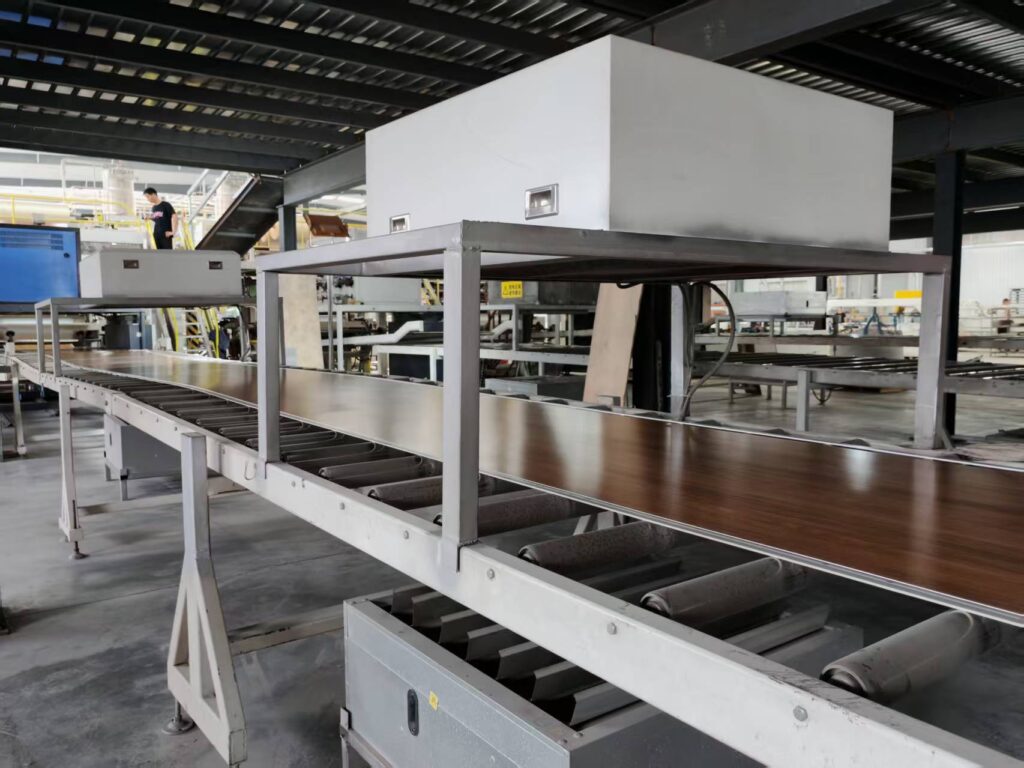
Flooring factories across China today are operating at high efficiency through use of automation, also including appropriate environmental management and highly-integrated processes. The Lanhe Flooring workshop contains state-of-the-art, fully-automated production lines which run around the clock to produce flooring with maximum efficiency and excellent quality which can be guaranteed consistently over large production runs. Using the latest robotics combined with precision engineering to produce very-high quality flooring, Lanhe produces a wide variety of quality flooring products.
Raw Material Selection and Preparation
Sourcing high-quality raw materials for production starts with sustainable harvesting of timber or the use of recycled fibers. We use only premium quality materials for our flooring, which guarantees the environmental safety as well as stability and performance of the end product. Raw fibers are thoroughly cleaned and processed in order to achieve uniform surface texture and then dried in preparation for mixing with high quality adhesive resins which are precisely formulated to guarantee optimal bonding power.
HDF Board Production Process
Our fibers are pressed into very dense panels and form the core of the panel. The thickness of these cores is checked automatically by a calibration system. The surface of the cores are sanded to ensure they can be used for lamination. All our cores are made with precise dimension tolerances to fit the locking system used later in the production process.
Decorative Printing and Impregnation Lines
Impregnating decorative papers with melamine resin and drying them in a controlled manner makes them more durable. Using color calibration sensors for color checking in printing, in order to keep the print pattern accurate even after printing in batches, plays a major role in print replication and determines the level of realism of the printed article. International buyers specifically look for replica wood grain prints and high quality print replication.
Lamination and Pressing Stages
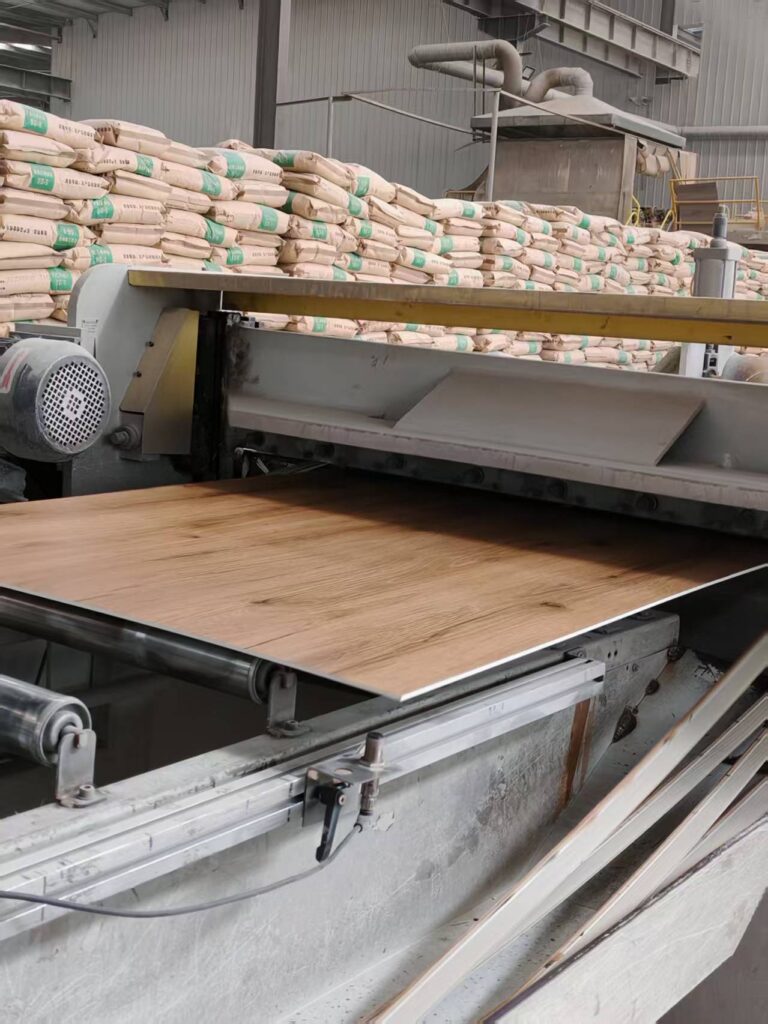
The multilayer assembly process involves layering wear-resistant overlays, decorative sheets, core boards and backing papers. They are then pressed together under heat, using hydraulic presses for bonding the layers. Cooling systems are used for stabilizing the sheet prior to cutting.
What Quality Control Measures Ensure Product Consistency?
Consistent quality remains central to every modern flooring manufacturer’s operations. At Lanhe Flooring, we maintain a rigorous quality control process to ensure that every piece of flooring meets the highest standards of durability, safety, and aesthetics. Factories adopt multi-stage inspection protocols aligned with EN13329 or ISO9001 certification requirements.
Dimensional Accuracy Testing
Automated scanners check for width, length and thickness tolerances during production. The edge profiling is accurate to allow for interlocking boards and easy site installation.
Surface Durability Evaluation
In Abrasion testing we establish the AC rating of your flooring by simulating years of wear and tear by foot traffic in the span of a few hours. The Impact tests for flooring assess the ability of your flooring to withstand dropped objects and how your flooring will react in such stress situations.
Moisture Resistance Assessment
We test samples in a humidity chamber and measure the expansion of the panel in different climate situations. The water absorption is measured to confirm that the formaldehyde emission of the sample complies with E1/E0 standards to guarantee safe indoor air.
How Are Locking Systems Engineered for Laminate Flooring?
Click lock panels are provided with locking mechanisms that can be opened without any tool and keep the joints tight during the life of the panels. Click lock panels are machined on CNC machines to form click lock profiles on the edges of panels. These profiles can be joined together with micrometer precision.
CNC Profiling Technology in Edge Design
The Milling machines are equipped with software that allows to cut locking geometries Unilin or Valinge standardized on the global market of flooring. All products with constant dimensions of tongue-and-groove are guaranteeing no gapping during installation and allows manufacturer to repeat same installation several times, which is a hallmark of advanced Chinese flooring manufacturing.
Mechanical Performance Testing of Locking Joints
Repeated engagement tests are carried out to check how the product performs in case of repeated cycles of assembly and disassembly. Shear load tests on joints are carried out to verify their strength when subjected to lateral loads. No adhesives or nails are required to ensure long-lasting performance.
How Do Environmental Standards Influence Production Practices?
Innovation is key in laminate flooring today. Innovation is driven by sustainability. At Room in Room we have put great effort in sustainability in our production processes and in developing products that are environmentally friendly yet of the best quality for a first class floor covering.
Emission Control Systems in Factories
Air filtration units capture volatile organic compounds emitted during resin curing phases; recovered heat energy from pressing lines reduces carbon output per production cycle—demonstrating commitment toward cleaner industrial operations.
Use of Eco-Friendly Resins and Recycled Materials
Manufacturers increasingly adopt low-formaldehyde adhesives meeting E0/E1 thresholds minimizing indoor emissions. Incorporating recycled wood fibers strengthens circular economy practices aligning with international green building certifications like CE or FloorScore compliance audits.
Who Is Shandong Lanhe Import and Export Co., Ltd.?
Shandong Lanhe is one of the China’s leading suppliers of laminate flooring, exporter who is dedicating to providing customers the best products made by combining the designs researched by innovative team and the automated productions. Shandong lanhe import and Export Co., Ltd. is one of the enterprises which is specializing in production and exporting, with a perfect and scientific quality management system.
Company Profile Overview
Our company is a professional factory with fully automated machines from raw material selection to finished product production, inspection and distribution. Our production is monitored closely by our professionals to ensure that the highest quality of products are produced. Our company is registered with ISO9001 and CE certifications. We offer OEM/ODM services to our distributors worldwide and have wide range of products including laminate flooring. Our laminate flooring products are designed to meet local market fashion trends and styles in different regions of the world.
Commitment to Quality and Partnership
Lanhe Flooring delivers the ultimate in quality, design and service by providing premium flooring products. At the core of our approach to the industry are our multi-stage inspection procedures and stringent packaging integrity procedures designed to ensure that all packages are delivered safely around the world. From the heart of Europe to the cities of Southeast Asia, we have an international customer base that continues to value our superior products and services.
What Are the Latest Technological Trends in Laminate Flooring Manufacturing?
China’s latest manufacturing technologies are being utilized in its latest laminate production to create the latest surfaces, blending realism with green credentials.
Integration of Digital Printing Technology
High-definition digital printing and custom designs are printed without waste using large-scale production lines. The designs are embossed in synchronization to provide a realistic and authentic feeling of real hardwood, to touch.
Automation Through Smart Manufacturing Systems
Smart AI sensors are deployed to monitor temperature and to ensure perfect uniformity of temperature across entire press. Also automated handling by advanced robots in state of the art fully automated factories, such as the ones operated by Shandong Lanhe Import & Export Co., Ltd., allow to minimize possible human mistakes and to reach highest possible through-put in production.
Why Is Global Demand Increasing for Chinese-Manufactured Laminate Flooring?
Cost optimized by China’s huge market base and with engineering expertise of high standard, the country is dominating global supply chain. It can export in huge volume and at the same time keep up international quality assurance requirements of architects and contractors. They are looking for suppliers from established places in the world and from big bases like Shandong in China.
Competitive Advantages in Production Scale
With the economies generated from its centralized sourcing network, China’s laminate manufacturers are able to maintain competitive prices while developing a wide distribution network across the world. As a result, China remains as the major exporter in global laminate market and is able to service in various residential projects across the globe via its fast fulfillment logistics. The logistics is optimized via integrated automation system.
Adaptation to International Market Requirements
By complying with the European REACH directives and having a versatile pattern portfolio, manufacturers such as Lanhe Flooring can cater to the needs of customers in different parts of the world, including those in North America and Oceania. As a result, Chinese flooring manufacturers are able to maintain a high level of export growth and reinforce their reputation of high quality, reliability, excellence in craftsmanship, precise engineering and high quality products offered by modern Chinese flooring factories, including Lanhe’s factory in Jinan, Shandong Province, which is well-known to professional buyers worldwide for offering high quality laminate flooring that is produced responsibly on a large scale and in compliance with the most current sustainability requirements of the global construction industry. Furthermore, compliance with the REACH directives and a diverse pattern portfolio will also empower these manufacturers to keep up with the latest innovations in material science and thus offer the latest surface technologies globally.
Conclusion: The Future Direction of Laminate Flooring Manufacturing
The production of Laminate flooring has integrated eco-friendly design with advanced digitalization, smart automation technologies and strict environmental protection strategies of major Chinese companies. Among them, Shandong Lanhe Import & Export Co., Ltd., a leader in China’s flooring industry, is at the vanguard of the industry’s technological innovations that deliver environmentally friendly, affordable and sustainable flooring solutions to customers around the globe.
FAQs About Laminate Flooring Manufacturing
What are the primary materials found in laminate flooring?
A laminate floor is made up of four main layers, including a wear-resistant coating, a decorative print, an HDF/MDF core and a backing stabilizer. These four layers are all fused together using heat in order to create a very durable floor that is suitable for a variety of both commercial and residential uses.
How long does it take to complete 1 production lot?
The duration of full-cycle manufacturing varies depending on the degree of automation and normally takes 24 hours up to 48 hours or more to complete the processes from fiber preparation to lamination to finishing and packaging.
Is laminate floor made in China environmental friendly?
Most Chinese made laminate floor meets E0/E1 low emission standard, contain recycled materials, low VOC emission, support for sustainable construction.
What determines the AC durability rating?
The wear-layer composition, the resin formulation, the pressing temperature and the results from the abrasion test. All of these factors together determine the classification-benchmarks for AC.
Can Shandong Lanhe offer customized patterns?
Yes, absolutely digital printing customization, client can tell us their desired color, texture and finish and we will make exactly the same design for the project.
