

A precise request for quotation, or RFQ, helps laminate flooring buyers receive comparable prices, realistic lead times, and products suited to their target market. A vague inquiry such as “Please quote 12mm AC4 laminate flooring” leaves major variables open, including core density, plank size, surface finish, click profile, packaging, and testing. A professional RFQ should define the product, project, compliance target, and commercial terms before a supplier prepares an offer.
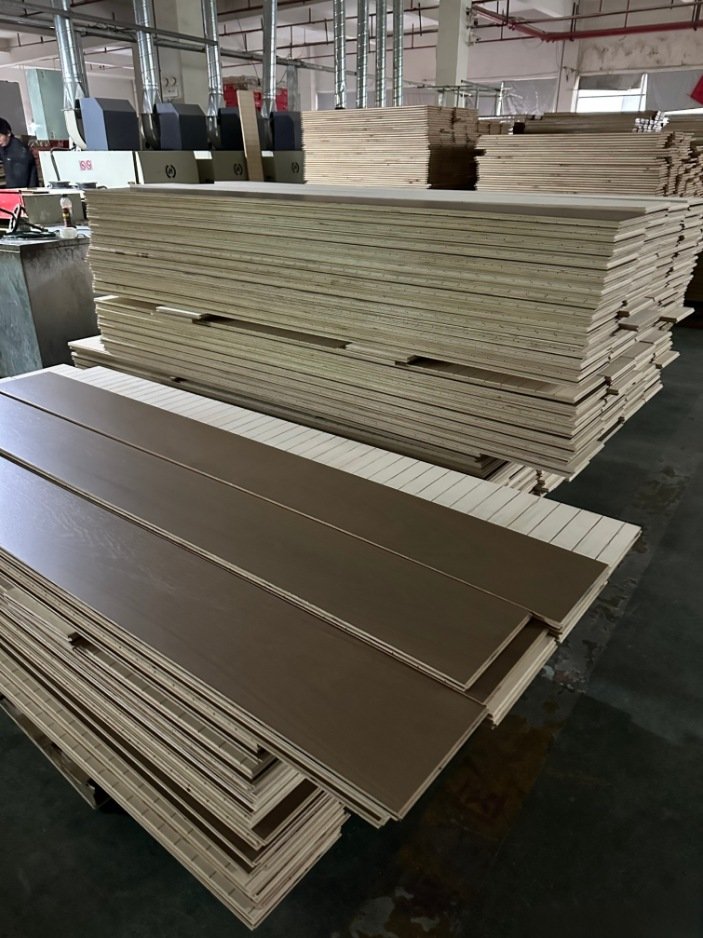
Why Does a Detailed Laminate Flooring RFQ Matter?
Two floors can share the same thickness and abrasion class while differing in raw materials, moisture performance, locking accuracy, appearance, and packaging strength. A detailed RFQ gives every supplier the same baseline and prevents buyers from comparing prices for products that are not equivalent.
Lanhe’s current laminate flooring range includes customizable patterns and sizes, thicknesses from 6mm to 12mm, AC1–AC5 options, and E0, E1, or E2 emission grades. This variety shows why a general product name is not enough.
Which 18 Specifications Should Buyers Include?
The following checklist can be adapted for residential retail, commercial projects, distributor stock, or private-label flooring programs.
Project Scope and Purchasing Plan
Begin with the business context so the supplier can recommend a suitable construction and calculate production and delivery accurately.
1. Application area. State whether the flooring is intended for homes, offices, hotels, retail stores, rental properties, or another environment. Note the expected traffic level and possible exposure to moisture or rolling loads.
2. Order quantity. Provide the square meters required for each color and specification. Separate the initial trial order from projected annual demand, as order volume can affect pricing and production planning.
3. Delivery schedule. Include the requested shipment date, destination port, and whether the goods will be shipped in one container or several batches.
Board Construction and Performance
After defining the project, set measurable technical requirements that directly affect durability, stability, and cost.
4. Finished thickness. Specify the target thickness and acceptable tolerance. Nominal thickness and measured thickness should not automatically be treated as identical.
5. Plank dimensions. List the exact length and width, dimensional tolerances, and product format, such as standard plank, wide plank, parquet, or herringbone.
6. Core material. State whether HDF or MDF is required and provide a target density range. Core color alone should not be used as proof of material quality.
7. Emission grade. Name the required formaldehyde or VOC grade and the test method accepted in the destination market. Ask which laboratory report supports the quoted product.
8. Abrasion class. Specify AC1, AC2, AC3, AC4, or AC5 according to the intended application. The RFQ should also identify the applicable testing standard.
9. Moisture performance. Define the required thickness-swelling result, water-resistance test, or edge-sealing treatment. Replace general “waterproof” claims with measurable acceptance limits.
10. Dimensional stability. Set criteria for flatness, squareness, bow, cup, and variations in plank length or width. These limits can reduce gaps and installation complaints.
Appearance and Installation Details
These items control what customers see and how installers handle the flooring. Reference photographs alone are not sufficient for mass-production approval.
11. Décor and color. Provide a décor code, physical sample, or digital reference. For custom orders, require a signed golden sample and state the permitted level of batch variation.
12. Surface finish. Choose matte, high gloss, embossed, EIR, hand-scraped, mirror, or another texture. For EIR flooring, define the acceptable alignment between the printed grain and embossed texture.
13. Edge profile. Specify square edge, V-groove, U-groove, painted bevel, or pressed bevel. Include the required bevel color where applicable.
14. Click system. Name the locking profile, installation method, and any compatibility or licensing requirement. Trial-installation checks should be requested when joint performance is critical.
15. Edge treatment. State whether wax sealing or another moisture-resistant treatment is required. Confirm whether the treatment should be applied to all four sides.
Packaging, Branding, and Quality Documents
A suitable floor can still generate claims if cartons fail, labels are incorrect, or the delivered production batch cannot be traced.
16. Packaging specification. Define the number of pieces and square meters per carton, carton strength, protective film, pallet requirements, corner protection, and container-loading method.
17. Private-label requirements. Provide carton artwork, barcodes, labels, installation instructions, pallet marks, required languages, and artwork approval deadlines.
18. Inspection and compliance documents. List the required reports, certificates, defect limits, pre-shipment inspection rules, and sample-retention requirements. The RFQ should also state the Incoterm, payment method, warranty request, and quotation validity period.
What Should Accompany the RFQ?
Attach a specification sheet, reference images, target décor samples, packaging artwork, and a quotation table. Ask each supplier to mark every requirement as “confirmed,” “alternative offered,” or “not available.” This format quickly reveals differences between quotations.
For custom products, use a clear approval sequence: décor sample, production sample, signed golden sample, and pre-shipment sample. The final purchase order should refer to the approved sample code and revision date.
Why Can Shandong Lanhe Import and Export Co., Ltd. Support Flooring Buyers?
Shandong Lanhe Import and Export Co., Ltd. supplies laminate flooring, SPC flooring, and related interior products. Its company materials describe quality control from raw-material purchasing through production, inspection, and delivery, together with exports to several overseas markets.
As a reliable SPC flooring supplier, Lanhe can support buyers seeking coordinated laminate and rigid-core collections, custom colors, private-label packaging, and export services. A complete RFQ allows its sales and technical teams to confirm suitable options, sample procedures, lead time, and documentation efficiently.
Conclusion
The best laminate flooring RFQ is not necessarily the longest document; it is the one that removes ambiguity. Define all 18 items, use measurable acceptance criteria, and attach approved references. Compare suppliers by product construction, testing, quality control, packaging, lead time, and total landed value—not unit price alone. This creates a stronger basis for sampling, contracts, inspections, and repeat orders.
FAQs
Is Thickness and AC Rating Enough for a Quotation?
No. These two details do not define core density, emission level, plank dimensions, surface finish, click system, moisture performance, packaging, or inspection criteria. A complete specification list is necessary for an accurate comparison.
Should Buyers Request a Sample Before Ordering?
Yes. Standard products should be checked against a current production sample. Customized products should have a signed golden sample recording the décor, gloss, texture, bevel, dimensions, and packaging version.
How Can Buyers Compare Supplier Quotations Fairly?
Use one RFQ form and require every supplier to answer each line. Separate confirmed specifications from proposed alternatives, and then compare price, test evidence, tolerances, lead time, packaging, payment terms, and warranty on the same basis.
