

Laminate flooring has become one of the most popular flooring solutions worldwide due to its durability, affordability, and realistic wood-like appearance. While consumers often focus on the finished product, few understand the sophisticated manufacturing process that transforms raw wood fibers into high-performance flooring planks. From producing a stable HDF core and applying decorative layers to precision profiling, quality inspection, and final packaging, every stage inside a laminate flooring factory plays a critical role in determining product quality and longevity. Understanding how laminate flooring is manufactured provides valuable insight into the technologies, materials, and quality control systems that ensure consistent performance in residential, commercial, and industrial applications. This article takes you inside a modern laminate flooring factory to explore the complete journey from HDF core production to finished plank.
What Happens at the Start of Laminate Flooring Production?
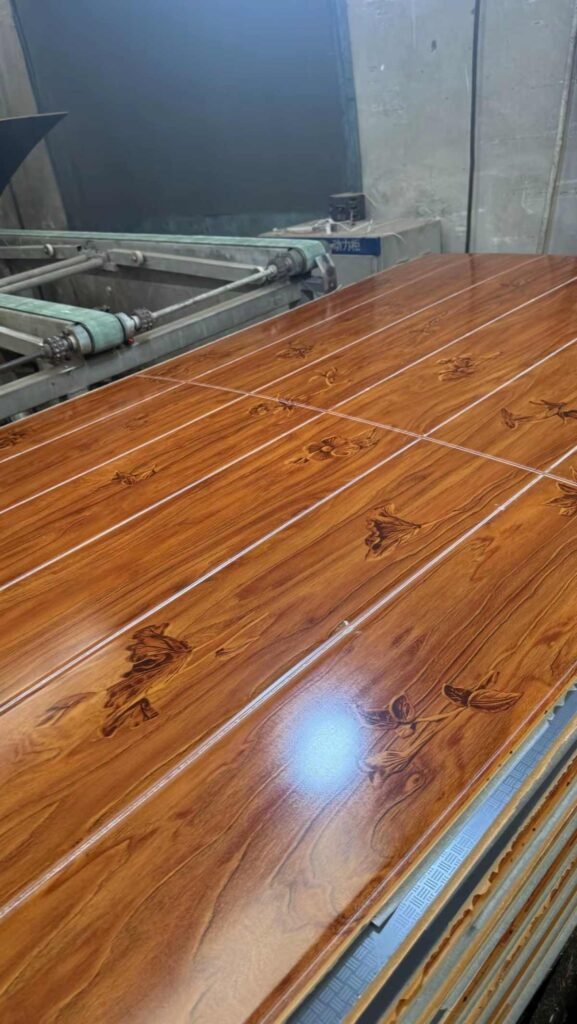
Laminate flooring production starts with the manufacturing of the high-density fiberboard (HDF) core, which is the core component of the plank. The HDF core is the main element that gives the floor its stability in size, moisture resistance, and performance during installation and in use.
The Role of Raw Materials in HDF Core Formation
The first step is sourcing wood fibers from sustainably harvested trees. This wood material is then refined, dried and combined with resins in order to enhance the fibers’ bond as well as the overall structure of the core material. Under heat and pressure this mixture is then formed into dense cores which serve as the foundation for the laminate flooring.
Laminate flooring is also called composite wood flooring, which is made of hardboard and medium-density fiberboard as the base material and impregnated paper film veneer layer, and the surface is coated with wear-resistant materials such as melamine and aluminum oxide. The base material layer is composed of wood fiber and resin adhesive treated under high pressure and temperature to provide stability and firmness. This ensures consistent density across each panel, enabling precise machining in later stages.
How Quality Control Ensures Core Consistency
The advanced automated systems at our factories are also designed to monitor density distribution and moisture content during pressing to guarantee consistency. Every floorboard is precisely cut and sanded to exact thickness using latest technology. Any defective cores are automatically detected and removed from processing to prevent any potential damage. Here at Lanhe Flooring, we carry out the most stringent quality control measures to guarantee every item of floorcovering to be of highest durability, safety and aesthetic appeal. That is why only the soundest HDF cores are selected for lamination.
How Is the Decorative Layer Applied to the HDF Core?
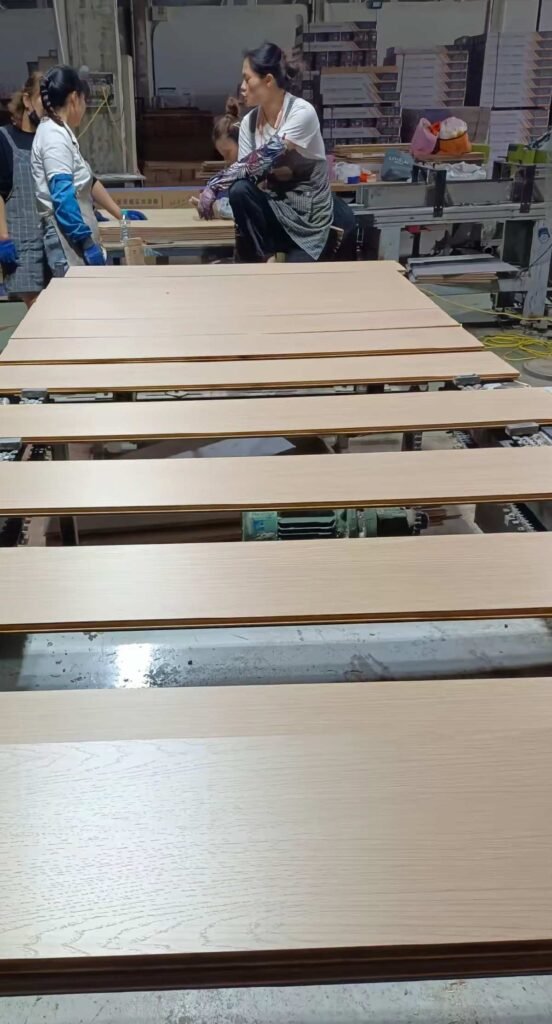
After the HDF core has been stabilized it is sent to the lamination line. In this department the various decorative papers and protective overlays are applied to the core by means of heat bonding. The look of the laminate flooring is determined in this department: the various woodgrains or stone-like looks as well as the wear resistance.
Printing and Impregnation of Decorative Paper
High-resolution printing replicates the look and feel of natural products such as oak, marble or walnut. The decorative papers are impregnated with melamine resins which provide excellent durability and water resistance while maintaining the deep, rich color tones of the print. The decorative layer is a layer of paper which has been impregnated with melamine resin. On top of this layer wood grain or other patterns of simulated noble tree species are printed. All products are subjected to continuous quality control in order to check for color consistency even across production batches. The finished planks all have a uniform look.
Lamination Process and Heat Bonding Techniques
All the layers – the overlay film, decorative paper, HDF core and the balancing layer – are fused together during the lamination process under controlled heat and pressure. The resulting flat single layer product has a smooth surface finish. When raising a texture, such as an embossed-in-register (EIR) design, onto a press during lamination, the resultant impression in the overlay film creates a very realistic tactile experience that matches up perfectly with the printed design.
Qualified laminate flooring consists of one or more layers of special impregnated thermosetting amino resin on top of a high-density board or other base material. This multiple layer flooring is resistant to scratches, stains and the wear of daily use.
How Are Planks Cut, Profiled, and Finished?
Large laminated sheets are cut into individual planks of exact dimensions in a workshop.
Precision Cutting for Dimensional Accuracy
Use Computer controlled saws to cut all panels in your project to exacting consistent sizes to keep waste to a minimum. Also edge trim to continue the decorative edge trim around the end of each plank to ensure continuity.
Profiling Technology for Click-Lock Systems
CNC milling machines are used to produce tongue-and-groove or click-lock profiles on the edges of panels. These interlocking panels can be fitted together without the use of adhesives, yet offer strong joints. The panels are very easy to fit.
Our workshop is equipped with state-of-the-art, fully automated production lines to ensure efficiency, precision, and consistent quality. Such automation guarantees repeatable accuracy across thousands of planks produced per day.
Surface Finishing for Enhanced Performance
Coatings with high abrasion resistance are used to protect surfaces and in combination with glossy surfaces to reduce glare when illuminated. Additional treatments such as anti slip and moisture repellent can be included if required for a specific regional market. The coatings can extend the life of a product and provide increased comfort to users in residential and commercial environments.
What Quality Assurance Measures Are Implemented Before Packaging?
Before shipment, every batch is subject to extensive mechanical testing on individual castings in order to check the performance against international standards.
Mechanical and Environmental Testing Procedures
Impact resistance tests simulate heavy foot traffic conditions; dimensional stability tests assess behavior under varying humidity levels; emission tests confirm formaldehyde levels meet E1 or CARB Phase 2 standards. Products are tested for wear resistance, impact strength, and water resistance to guarantee long-lasting performance in diverse environments. Environmental testing further ensures low VOC emissions consistent with FloorScore or CE certifications.
Visual Inspection and Batch Traceability
Surface quality is inspected for surface defects such as discoloration or scratches under controlled illumination by the operators. Each pallet is labeled with a pallet-label with a barcode, enabling full traceability through all logistics channels from the factory floor to the end customer delivery.
How Is Shandong Lanhe Import and Export Co., Ltd. Contributing to Global Laminate Flooring Supply?
Shandong Lanhe Import and Export Co., Ltd. is a business based in the flooring production hub of Jinan in China. The company uses the latest technology and follows sustainable production methods. Shandong lanhe import and Export Co., Ltd. is a production and export oriented company with a complete and scientific quality management system. Our company is one of the most advanced professional companies using fully automated machines. We produce flooring from purchasing raw materials to processing and quality checking and delivering to customers all over the world. Our products are widely recognized and exported to North America, Europe, Australia and Southeast Asia. They are known for their reliability and style.
Lanhe Flooring is a supplier of premium quality flooring products with innovative designs and first class service. The Lanhe Eco-friendly production line reflects Lanhe Flooring’s commitment to the environment while continuing to supply high quality products to customers worldwide.
Why Does Manufacturing Efficiency Matter in Laminate Flooring Production?
Efficiency enables cost competitiveness through efficient use of materials, energy savings, increased productivity of personnel and faster execution of orders in large production volumes of flooring.
Streamlining Production Through Automation
Automating the feeding of workpieces into the processing centers is critical in eliminating idle time between centers. Also, by using robots for the lifting and stacking of parts as well as for packaging, we can greatly reduce the amount of manual lifting required and also ensure very accurate alignment. The goal of such automation is to support a continuous-flow production model and meet the demanding global market requirements in an efficient manner.
Energy Optimization in Modern Factories
Most modern plants these days are set up with heat recovery off press exhaust which is then used to dry lines within the plant. This once lost energy is a significant factor in the overall power consumption of the plant. This in turn is monitored by smart software’s to measure energy consumption per cycle allowing for ongoing improvements towards the Sustainability goals of companies such as Lanhe Flooring.
What Are Future Trends Shaping Laminate Flooring Manufacturing?
As consumers demand more personalized offerings and greener products, manufacturers can harness digital technologies to unlock new ways to work with green chemistry.
Digital Printing Innovations in Decorative Surfaces
Direct digital printing of our flooring designs enables the elimination of paper waste in production and also allows for unlimited design possibilities. Each plank can feature different grain details which are all generated in a non-repetitive manner by the use of variable texture mapping to create even greater realism than that possible with conventional print films.
Sustainable Material Development in HDF Cores
There are emerging bio-based resins on the market that can be used to replace formaldehyde adhesives reducing emissions from the factories. Also within the factories there are recycled wood fibers being used in order to meet the objectives of the circular economy. The factories are working towards zero-waste and being granted a recognized global certification for environmental responsibility. Top manufacturers such as Shandong Lanhe Import & Export Co., Ltd. are using these types of resins and fiber in their production.
The manufacturing of laminate flooring includes the engineering and design of all processes from core formation to lamination and final inspection. Innovation is key to maintaining high quality as well as ecological responsibility in today’s industry.
FAQs
What distinguishes an HDF core from MDF in laminate flooring?
With greater density than MDF HDF is stronger more stable and offers better resistance to moisture. This makes HDF surfaces ideal for use in locations where there will be constant footfall over extended periods of time.
How does embossing-in-register technology enhance laminate flooring?
Embossing-in-register ensures that the embossing surface features correspond with the grain features printed on the surface, to deliver a truly realistic tactile experience similar to real hardwood.
Can laminate flooring be considered environmentally friendly?
Yes, when made with low-emission resins from recycled fibers, from certified sustainable wood sources, and with a closed-loop production process to minimize waste in all phases of production and comply with top environmental standards worldwide.
