

Laminate flooring peaking appears as raised ridges at plank joints, where end seams or side connections lift upward into small peaks. Installers and homeowners encounter this months or years post-lay, particularly during humidity transitions—higher levels in spring and summer often trigger it after drier winter periods. In Southern California regions like Los Angeles, coastal moisture combined with inland dry spells creates ideal conditions for the issue to surface. Multiple factors typically converge: restricted natural expansion, environmental swings, and occasional oversights during setup.
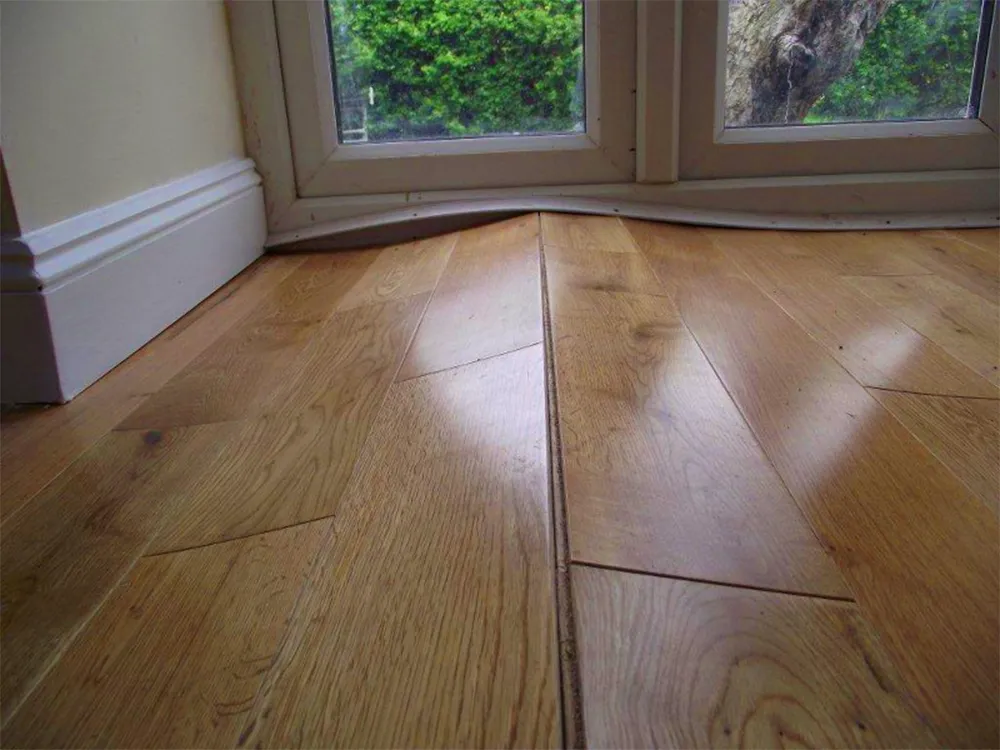
This breakdown examines documented causes of laminate flooring peaking, diagnostic steps to gauge extent, practical repair sequences, and measures to minimize recurrence. Clear identification prevents escalation from minor seam issues to lock damage or broader replacement needs.
Peaking vs. Buckling vs. Cupping vs. Lifting: Key Distinctions
Peaking concentrates at joint lines, with planks pushing upward precisely where they connect, while the plank body remains mostly level against the subfloor.
Buckling covers wider sections, where multiple rows arch or tent upward under uniform pressure from expansion or deep moisture.
Cupping shows plank edges rising while centers dip, usually from one-sided moisture absorption through the core thickness.
Lifting involves complete detachment from the subfloor, producing hollow zones or visible under-plank gaps.
Accurate differentiation directs the right approach. Peaking frequently resolves with perimeter relief, whereas buckling demands subfloor moisture checks or partial tear-out. A quick field test—applying weight over the peak for a day or two—reveals if it settles flat, confirming restricted movement over permanent core damage.
Primary Causes of Laminate Flooring Peaking Observed in Practice
Restricted expansion gaps stand as the dominant factor in field reports. Laminate functions as a floating system that must accommodate thermal and hygroscopic movement. Standard guidelines call for 8-12 mm clearance along all fixed boundaries—walls, jambs, pipes, and cabinet toes. When baseboards pin edges, thresholds clamp down, or heavy furniture blocks flow, accumulated stress forces joints to peak at laminate seams peaking up.
Seasonal humidity fluctuations accelerate the process. Dry winter air contracts planks; subsequent spring or coastal humidity increases cause swelling. Marginal gaps fail to absorb the change, directing pressure upward. Los Angeles installations often reflect this pattern—air-conditioned summers drop indoor levels, rainy periods spike them, and unmonitored swings push laminate flooring peaking at joints.
Inadequate acclimation during setup contributes significantly. Material delivered cold and laid promptly in conditioned spaces starts undersized. As room humidity equilibrates, excessive expansion occurs. Protocol requires 48-72 hours in-place conditioning, yet compressed timelines or overlooked staging lead to delayed peaking.
Subfloor irregularities compound risks. Unevenness exceeding 3 mm over 3 meters, residual moisture above acceptable thresholds (typically under 3-4% for slab or 12% for wood), or adhesive remnants create pressure points. In expansive residential or light commercial areas, these variations multiply effects across the layout.
Doorway transitions and reducers concentrate force. Fixed moldings that immobilize plank ends initiate peaking that radiates outward.
Core material performance varies widely. Lower-density HDF absorbs moisture quicker, exhibiting higher thickness swelling rates that exacerbate joint lift. Locking mechanisms with inconsistent tolerances permit slight play, allowing cumulative micro-shifts to manifest as visible peaks over cycles.
Less frequent triggers include direct water exposure from spills or aggressive wet cleaning, which saturates edges and swells the core beyond design limits.
Assessing Peaking Severity: Systematic Evaluation
Begin with a load test: position substantial weight across the raised seam for 24-48 hours. Complete flattening indicates mild restriction amenable to adjustment.
Inspect perimeter clearance by probing gaps (baseboard removal may help). Clearances below 5-6 mm confirm compression.
Monitor indoor relative humidity via hygrometer. Sustained readings outside 35-55% correlate with environmental contribution, common in variable California climates.
Scan for secondary signs—creaking underfoot or hollow tapping suggests subfloor contact loss or lock fatigue.
Map distribution: localized peaks near entries imply transition faults; room-wide occurrence signals perimeter-wide restriction or acclimation shortfall.
Mild instances (isolated, weight-responsive) lend themselves to straightforward intervention. Moderate spread across zones calls for targeted disassembly. Severe cases featuring lock fractures or core delamination warrant specialist review or selective board replacement.
Repair Procedures: Progressive Steps from Basic to Comprehensive
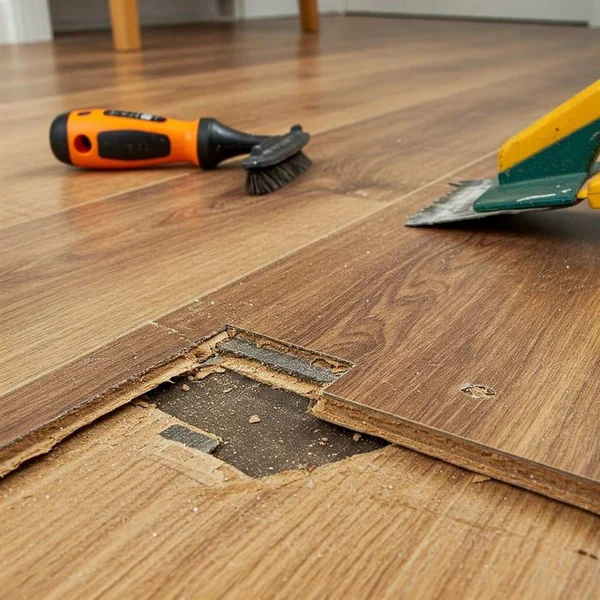
Address mild peaking by easing boundary constraints.
Detach baseboards methodically with a flat pry tool. Extend expansion zones along walls and obstacles using an oscillating cutter or guided saw, targeting 8-12 mm uniform space. Remove cuttings and vacuum thoroughly.
Apply distributed load—weighted containers or stacked materials—over affected zones for 48-72 hours to promote settling.
Reattach trim, positioning it to preserve the cleared gap without contact.
Moderate peaking often originates at thresholds. Elevate reducers, trim underlying plank ends for relief, then reseat components loosely.
Extensive areas necessitate sequential disassembly from outer edges. Label rows for orientation. Trim edges to reinstate gaps, verify subfloor levelness with a long straightedge, and re-lay over refreshed underlay if compacted.
Damaged locking elements in heavy peaking require plank substitution. Source matching stock from identical production runs to minimize visual variance. Install replacements with care to maintain float.
Throughout, preserve floating principles—no adhesives or mechanical fasteners that immobilize the system.
Prevention Strategies: Material Selection and Installation Discipline
Effective prevention integrates preparation, execution, and ongoing management.
Condition material onsite for minimum 48 hours, extending to 72 in fluctuating environments. Stack cartons loosely to facilitate airflow.
Confirm subfloor tolerances and dryness prior to commencement. Employ moisture meters and corrective compounds as indicated.
Maintain disciplined expansion margins around all perimeters, including interior obstacles and heat sources.
Regulate indoor conditions consistently—target 35-55% relative humidity through seasonal humidification or dehumidification. This practice mitigates many cyclic laminate floor peaking issues in coastal and inland settings.
Core density and treatment influence durability. Higher-density HDF cores demonstrate lower swelling coefficients. Edge-sealed and moisture-resistant formulations provide additional barriers. Tight-tolerance click systems reduce inherent play at connections. Balanced construction with stabilizing backer layers counters uneven response.
Products engineered for dimensional control—minimal expansion rates and robust lock geometry—perform reliably across humidity variations typical in export destinations.
About Shandong Lanhe Import and Export Co., Ltd.
Shandong Lanhe Import and Export Co., Ltd., situated in Jinan, maintains automated production facilities with integrated quality oversight from raw inputs to outbound shipment. Laboratory sampling verifies material properties; in-line inspectors monitor dimensional accuracy, locking engagement, and surface integrity; finished goods undergo wear, impact, and water resistance evaluations. VOC compliance aligns with FloorScore and CE requirements. Laminate lines incorporate dense cores, protective treatments, and precise click mechanisms suited to varied climates and sustained performance in residential and commercial contexts across North American, European, and other markets.
Conclusion
Laminate flooring peaking predominantly arises from constrained movement, seasonal environmental shifts, or installation details that limit accommodation. Timely perimeter adjustments and humidity management resolve the majority of instances before lock integrity suffers. Prioritizing stable core materials, accurate locking profiles, and methodical setup protocols substantially lowers susceptibility, particularly where humidity cycles prevail. Addressing underlying contributors yields level, stable surfaces with extended service life.
FAQs
Why is my laminate flooring peaking at the joints after installation?
Peaking at joints commonly results from insufficient expansion allowance around walls or fixed elements. When planks swell with rising humidity and encounter resistance, pressure directs upward at connections. Enlarging perimeter gaps frequently corrects this.
How do I fix laminate flooring peaking without full replacement?
Relieve restriction by cutting 8-12 mm expansion zones along boundaries after baseboard removal. Apply weight to peaked seams for several days. Adjust doorway transitions if involved. These measures address most mild to moderate laminate seams peaking cases.
Does seasonal humidity in California cause laminate flooring peaking?
Seasonal humidity shifts in California, from dry winters to humid coastal or rainy periods, prompt plank expansion. Inadequate gaps channel this into upward joint movement. Consistent indoor humidity control between 35-55% reduces recurrence of laminate flooring peaking at joints.
Is laminate flooring peaking typically covered by warranty?
Warranties generally address manufacturing flaws but exclude peaking tied to installation practices, such as omitted expansion gaps or skipped acclimation. Environmental influences and site-specific conditions usually fall outside standard coverage terms.
How can I prevent laminate flooring peaking in variable climates?
Incorporate proper acclimation, consistent expansion gaps, and humidity monitoring during installation. Select laminate with high-density moisture-resistant cores and precise locking systems. These steps minimize risks of peaked laminate floors over time.
