

Laminate flooring bubbling shows up in humid interiors far more often than most people expect. And almost always later than anyone would like. In regions with long rainy seasons, coastal weather, or buildings where kitchens and bathrooms sit close to living or commercial spaces, this issue rarely points to a single mistake. It tends to surface after moisture has been quietly working its way through the system for a while.
For distributors, contractors, and project teams, this kind of failure is frustrating precisely because it doesn’t announce itself early. By the time edge swelling or joint uplift becomes obvious, schedules are already affected and responsibility is being questioned. At that stage, it stops being just a technical topic and becomes a commercial one. Many problems trace back to how surface-level water resistance is misunderstood and overestimated during selection and planning.
What follows is not a checklist, but a closer look at how moisture behaves in real projects, and why prevention usually depends more on timing and coordination than on any single product feature.
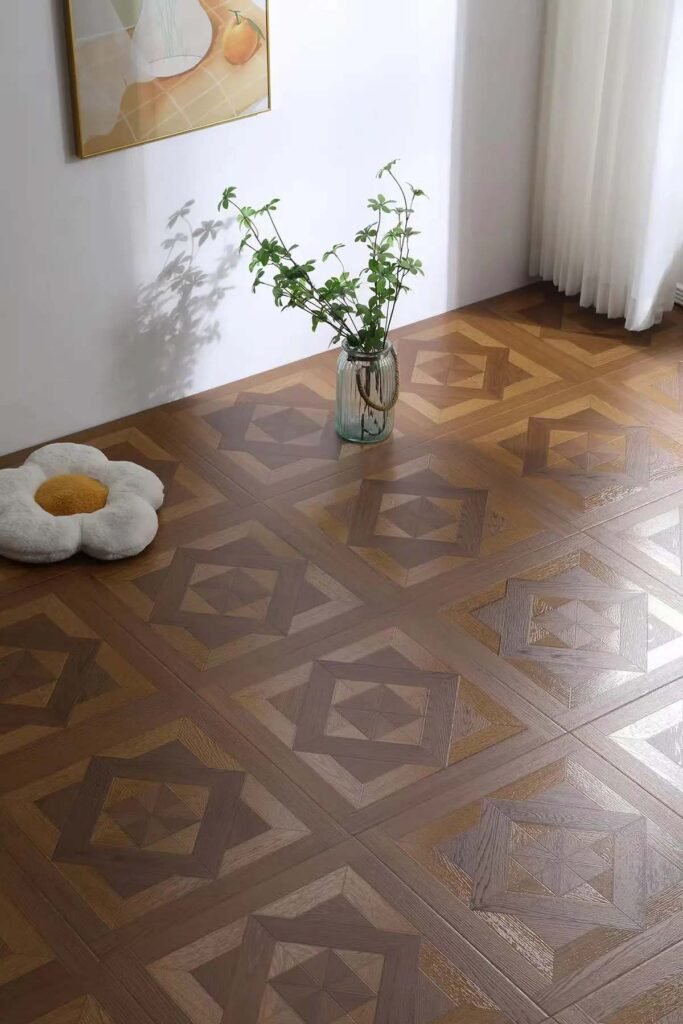
What Bubbling Looks Like Before Anyone Calls It a Problem
On site, bubbling rarely starts with a dramatic failure. It usually begins with small, easy-to-ignore signs. A seam that feels slightly raised near a wall. A short edge that catches light differently in the afternoon. A hollow sound underfoot near a doorway.
Technically, this is localized swelling rather than overall movement. It often gets confused with buckling or cupping, but the mechanics are different. Moisture tends to build where movement is restricted—along fixed edges, under cabinets, or at transitions. As internal pressure increases, joints lift first. The surface layer may still look intact, which is why the issue is often underestimated early on.
Most laminate systems rely on a dense fiberboard core. Even when treated, that core reacts to moisture. When exposure is slow and repeated, fibers expand and do not fully recover. Over time, that pressure finds the weakest path upward. In many cases, there is no visible water and no clear leak to blame.
Why Damp Air Causes More Trouble Than Spills
Moisture That Never Quite Leaves
Spills are straightforward. They happen, they get noticed, they get cleaned. Damp air is less cooperative. When indoor humidity stays elevated for long periods, moisture moves gradually, often unnoticed, through air and materials that feel dry to the touch.
During extended wet seasons, indoor conditions often hover in a range where moisture exchange never really stops. The floor does not get soaked, but it also never fully dries. Over time, the core absorbs just enough moisture to move outside its stable range. Expansion follows, usually after the weather itself has already changed. This delay is why bubbling often seems disconnected from the rain that caused it.
Condensation Below Finished Floors
Condensation is another factor that tends to be overlooked. Concrete slabs cool more slowly and unevenly during rainy periods. Warm, moisture-heavy air meets a cooler surface, and condensation forms below the finished floor, not on top of it.
Once moisture is trapped under the boards—especially where underlayment and perimeter trims limit airflow—it stays there. This bottom-up exposure is particularly damaging because it is continuous. It explains why ground-floor units and long corridors often show joint uplift before anyone notices a broader humidity issue.
Kitchens and Bathrooms: Familiar Spaces, Unfamiliar Risks
Kitchens and bathrooms introduce moisture in ways people think they understand, but often underestimate.
In kitchens, problems rarely come from a single spill. They come from repetition. Steam from daily cooking, condensation behind appliances, small leaks that dry slowly, and frequent damp cleaning all contribute. Moisture enters seams in small amounts, but often. Over time, joints become the weak link, regardless of how well the surface performs.
Bathrooms are more demanding. Steam raises humidity quickly. Floor temperatures change after showers. Drainage details matter more than expected. Some water-resistant laminate products perform reasonably well in dry zones, but the margin for error is narrow. Without good ventilation and careful detailing, edge swelling tends to show up earlier than anyone plans for.
Surface Protection and the Limits of It
One of the most common misunderstandings during sourcing discussions is assuming that a waterproof surface equals long-term moisture safety.
Surface coatings do what they are designed to do. They slow liquid penetration from above and make cleaning easier. What they cannot do is stop vapor movement, moisture entering through joints, or emission from the subfloor.
Whether moisture-related deformation develops depends on how several factors interact over time. Core density influences how quickly moisture is absorbed. Edge sealing and locking systems slow entry but do not eliminate it. The balance layer helps manage stress but cannot correct prolonged imbalance. Installation conditions—subfloor moisture, vapor control, expansion allowance—often determine the outcome more than any single product feature.
Seen this way, surface protection is part of the system, not the system itself.
Conditions That Make Problems Show Up Faster
Moisture Coming from Below
Concrete does not stop releasing moisture simply because it looks dry. In both new builds and renovations, floors installed over slabs with elevated emission rates are exposed from day one. If moisture control is skipped or rushed, swelling tends to appear gradually and persistently.
Limited Room to Move
Laminate flooring is designed to move. In damp conditions, it needs more room, not less. When boards are installed tight to walls or heavy fixtures, expansion pressure concentrates at joints. Joint uplift is often the first sign that movement has nowhere else to go.
Moisture That Has No Exit
Some underlayments slow vapor movement but also trap moisture once it enters. When evaporation paths are limited, prolonged contact between moisture and core accelerates deformation more than brief wetting ever could.
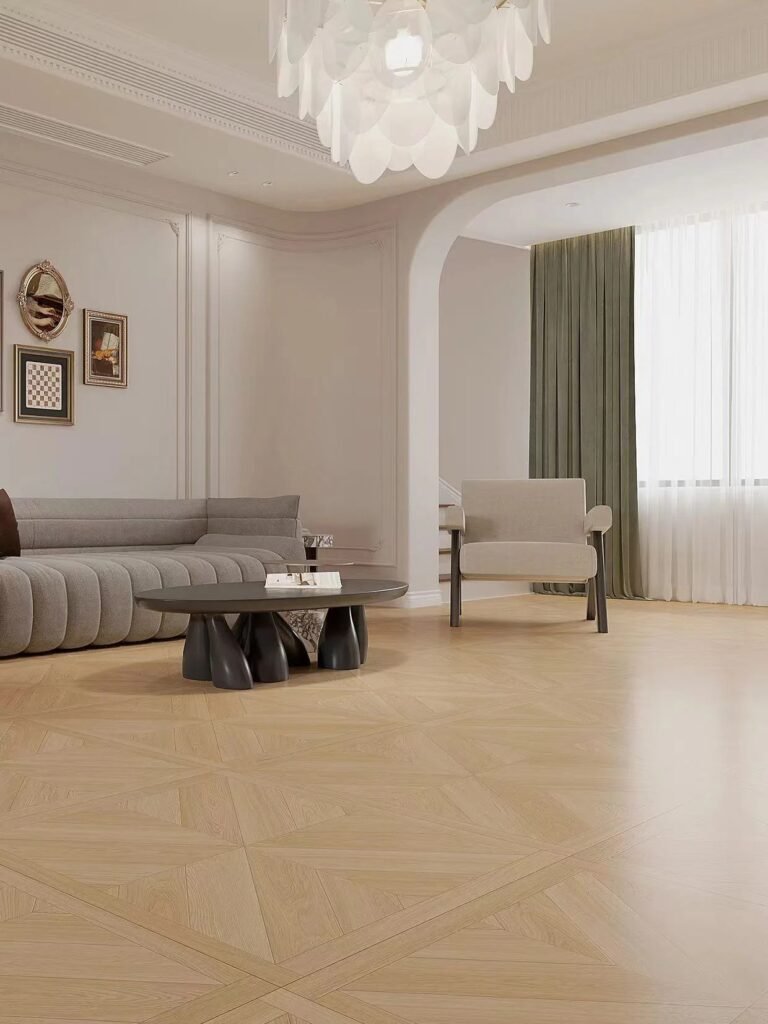
Reducing Risk Before Installation Becomes a Topic
Most effective prevention happens early, often before materials arrive on site.
In humid regions or rainy-season schedules, indoor conditions need to be treated as part of the flooring system. Installing while humidity is uncontrolled increases risk that cannot be undone later. This is particularly relevant in hospitality and commercial projects where climate control may not be fully active during fit-out.
Subfloor preparation carries equal weight. Moisture testing, properly detailed vapor barriers, and clean substrates are baseline requirements, not formalities. Product selection matters too. Denser cores and well-sealed joints behave more predictably under moisture stress. In consistently damp environments, alternative core structures may simply make more sense, and a responsible supplier should say so.
A Reality Check for B2B Decision-Makers
From a commercial perspective, this type of failure almost never traces back to one bad decision. It builds up. Each shortcut—skipped testing, overreliance on surface claims, rushed installation during wet weather—adds pressure to the system.
For distributors and project teams, working with a manufacturer that understands these interactions reduces long-term exposure. Clear documentation and realistic application guidance often prevent more problems than bold performance statements once projects scale.
About Shandong Lanhe Import and Export Co., Ltd.
Shandong Lanhe Import and Export Co., Ltd., located in Jinan, Shandong, China, supplies laminate flooring and related interior solutions to residential and commercial partners worldwide. By integrating manufacturing, quality control, and export operations, the company focuses on stable specifications and practical guidance for real project conditions. Its products are supplied to partners across Europe, North America, Australia, and Southeast Asia, with an emphasis on long-term performance rather than short-term claims.
Conclusion
In a high-humidity environment, the appearance of bubbles in the laminate flooring is not due to any defect in the material itself, but rather because the movement of moisture is characterized by slowness and cumulative nature, which is often underestimated. During the rainy season, in the kitchen and bathroom, steam, condensation water, and repeated low-level contact occur, which over time pose challenges to the flooring system. Understanding the limitations of surface protection and focusing on humidity control at the system level can help B2B buyers reduce the number of site visits and protect project profits. When humidity risk management is regarded as a process rather than a feature, laminate flooring can operate reliably even in harsh environments.
FAQs
Why does bubbling appear after rain when no leaks are visible?
In many cases, prolonged humidity and condensation are responsible. Moisture enters as vapor through joints or from the subfloor and builds up gradually until deformation becomes visible.
Are kitchens and bathrooms suitable for laminate flooring?
They can be, but conditions matter. Repeated humidity, steam, and condensation increase risk, especially without good ventilation and detailing.
Does surface water resistance prevent bubbling?
It helps with spills, but long-term prevention depends on core behavior, joint protection, vapor control, and installation conditions working together.
How do professionals reduce risk in damp environments?
They control indoor conditions, test subfloors, allow sufficient movement space, and choose products based on actual use conditions rather than surface claims alone.
When is laminate flooring not the right choice?
Areas with standing water, uncontrolled humidity, or persistent subfloor moisture that cannot be managed are better served by other flooring systems.
