

Before approving SPC flooring for a cabinet, I would ask to see how it was assessed with a load held still. A rolling-chair result would leave me asking the same question: what about the feet that do not move? Residual indentation is the depression still present once the weight has been removed and the specified recovery period has passed. Without knowing the support, assembly and timing, I would find it hard to interpret either a measured mark or a claim that the sample passed.
Describe the stationary furniture before requesting a test
Here is a hypothetical situation to work through: you are buying a floor for a shop, where a display cabinet will stand on narrow metal feet. I would begin the enquiry with a sketch of one foot. Asking only whether the floor can carry “heavy furniture” leaves the supplier guessing at the support you have in mind.
Weight is only part of the description
Suppose the same weight rested on a broad cabinet base instead. The pressure would be spread across more area, so the original narrow foot and this broad base would not be equivalent test supports. I would give the factory the foot dimensions and material, number of supports and total load together. Leaving out the contact shape makes it too easy for two suppliers to answer different versions of the enquiry.
Keep rolling-chair evidence for the moving condition
Caster travel involves turns and repeated contact. It is useful to assess, but I would not use it to answer the cabinet question. The article on SPC flooring and rolling office chairs deals with that moving condition. For a project containing chairs and cabinets, I would ask for two identifiable answers in the buying file. Otherwise, I could not tell which use the pass statement concerned.
Does the test assembly match the floor on the quotation?
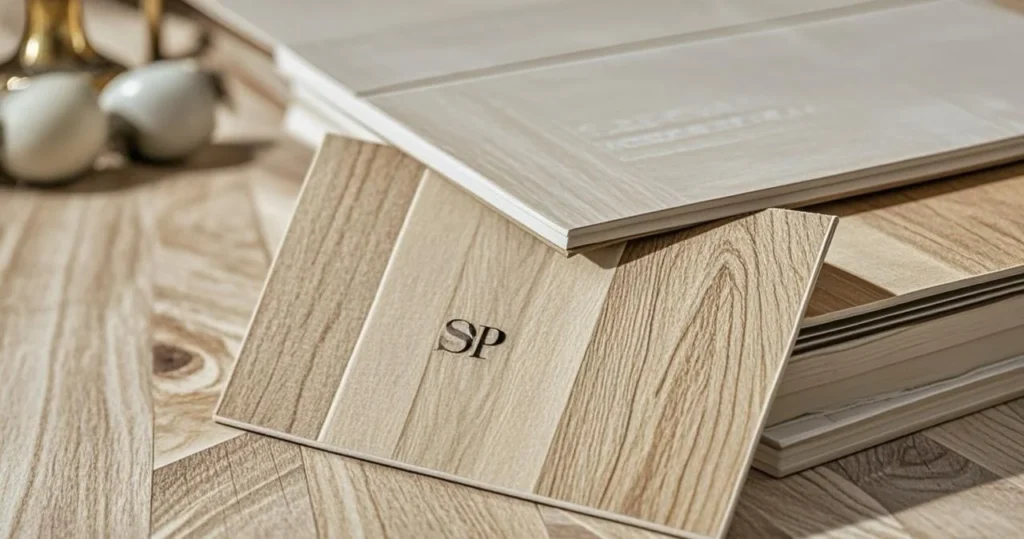
Next I would look beneath the fixture. SPC has a rigid core and surface layers, and the response also depends on any attached pad. Was the test done on a loose piece, or on the assembly you plan to install? I would settle that before comparing reports; the quotation and the tested object need to describe the same proposed construction.
Name the backing and installation conditions
If an IXPE, EVA or cork pad is supplied, identify it in the sample record. The substrate, its flatness, plank direction, underlayment and edge clearance belong there too, along with temperature and humidity where controlled. When comparing the SPC flooring range, I would ask for the full quoted construction rather than accept “SPC” as the entire sample description.
Give the specimen a product reference
For an enquiry about Oak 31805-1 SPC flooring, keep that reference with the finish, dimensions, wear-layer description, core version and pad. You can then explain which sample produced the result. The model name does not approve our hypothetical cabinet condition, though. That still needs an agreed loading procedure and a decision based on the evidence.
What would make the static-load result useful?
With the support and assembly described, there is finally a clear test question. I would want the initial condition recorded, then the load applied and removed, with inspections at agreed times. A report saying only “passed” skips the information needed to understand that answer.
Settle the procedure before the acceptance limit
ASTM F970 publishes a method concerning recovery after static loading. I would ask the laboratory whether its scope and procedure suit the SPC construction and the particular claim being assessed. Citing it is not an automatic approval. The RFQ still needs the fixture, contact area, loading period, environment, recovery interval and inspection method, with the proposed acceptance limit attached to those conditions.
Record appearance separately from indentation depth
Take photographs of an undamaged area before loading, using consistent light for the later comparison. Say how depth or flatness is measured as well. After unloading, a reviewer might also find whitening, gloss variation, a crack, edge movement or click damage. I would keep those observations distinct from the depth reading, even if they also affect acceptance. Otherwise it becomes difficult to tell which defect led to the decision.
How would you carry the decision into production?
Return to our hypothetical cabinet. Can the supplier’s answer be read against that support, that floor assembly and the agreed recovery rule? If something is missing, I would ask about the gap before approving the sample. A rolling-chair report would not fill it. You would still be waiting for an answer about the stationary metal feet.
Keep a master piece for the approved décor, finish and edge profile, with the test record, photographs and decision beside it. The physical reference helps with appearance; the written record explains the loading review. If the quotation later changes the backing or construction, revisit the approval rather than assuming the old result follows the new product. That also leaves the inspector a clearer reference when a production batch arrives.
Discussing the SPC enquiry with Lanhe Flooring
On the Lanhe Flooring About page, the company outlines its production and export work and the quality control it describes from buying materials to inspecting and delivering goods. For an SPC enquiry, you can request a quotation using your floor build-up and furniture-foot sketch as the starting point. Ask which available sample corresponds to that request. I would keep questions for the laboratory in the same correspondence, clearly open until they had been answered.
Conclusion
I would approve the cabinet condition only once I could read the answer against the agreed support and recovery procedure. Keep that account with the complete sample description. If the quoted backing or construction changes later, there is then something specific to revisit rather than a general memory that the floor had passed.
FAQs
Does furniture weight alone define the static load?
No. Contact area and the number of supports also matter; equal weights can produce different local pressures.
Is a gloss change an indentation measurement?
No. Record it as an appearance observation, separately from measured depth. Both can be considered under the agreed inspection rule.
What if the supplied backing differs from the approved sample?
Revisit whether the approved assembly and result still apply. Keep the revision and resulting decision with the sample record.
