

If you manage a hotel or a serviced apartment building, you probably get pulled between two forces all the time: guests want something that feels warm and high-end, while your maintenance team just wants a floor that won’t drive them crazy.
Carpet stains, swollen wood near the minibar, chipped tiles in the corridor… none of that looks good in a review. So the question comes up more and more in project meetings:
“Can we use laminate flooring here, or will it look cheap and wear out too fast?”
The honest answer: laminate flooring can be a very solid choice for hospitality projects, but only if you treat it as a technical material, not just “pretty planks”. Let’s walk through where it fits, where it doesn’t, and what to ask your supplier before you commit.
What Hospitality Floors Deal With Every Day
Real-world traffic, not showroom traffic
Think about one floor in a typical business hotel:
- Guests rolling hard-shell suitcases from the elevator to the last room on the corridor
- Housekeeping trolleys coming and going all day
- High heels, wet shoes, kids running, furniture dragged a little too hard
- Daily vacuuming and mopping by staff who are racing the clock
Serviced apartments add even more: cooking, rearranged chairs, food delivery bags and boxes. The floor doesn’t get a day off.
So any material you choose has to be more than “nice looking”. It needs a hard, stable surface layer and a core that won’t deform every time someone wheels a trolley over the same line.
One building, many zones
Hotels and serviced apartments are really several micro-projects under one roof:
- Guest rooms – focused on comfort and a cozy look
- Corridors – narrow, long, and punished by rolling loads
- Lobbies and lounges – where the brand makes its first impression
- Kitchenettes and entry strips – small areas that see a lot of moisture and dirt
If you can cover most of these with one flooring system that can be tuned by thickness, class and design, you make life easier for designers, buyers and maintenance staff.
What Modern Laminate Flooring Actually Is
Old-school laminate had a bad reputation: thin, noisy, obviously fake. That’s not what serious manufacturers are shipping today.
A typical quality laminate plank from a producer like Lanhe looks more like a small sandwich of engineered layers:
- A high-density or medium-density fiberboard core, with density in the higher range so the board feels solid and resists impact
- A decorative paper layer that carries the wood, stone, or parquet design
- A melamine surface with aluminum oxide in the wear layer, which gives the plank its abrasion class and scratch resistance
You’re not just buying “a picture of wood”; you’re buying a structured board with known performance.
Wear rating and thickness – not just marketing numbers
In your spec sheets you’ll see AC classes (AC1–AC6) and thickness options like 7, 8, 10, 11 or 12 mm. For hospitality, a rough rule of thumb looks like this:
- Guest rooms: AC3–AC4, 8–10 mm
- Corridors and elevator lobbies: AC4–AC5, 10–12 mm
- Serviced apartments: similar to guest rooms, sometimes with a small upgrade in class for kitchen zones
Thicker boards combined with a proper underlay help with both feel and acoustics. Guests rarely comment on AC ratings, but they do notice if the floor sounds hollow or cheap when they walk across it.
Surface feel: gloss vs. matt, smooth vs. textured
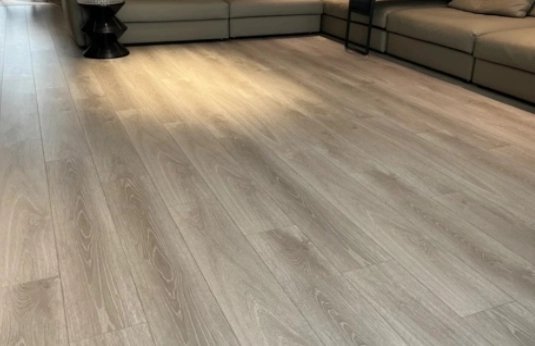
Modern laminate doesn’t have to be shiny. Lanhe, for example, offers surfaces in high gloss, matt, embossed, embossed-in-register and handscraped.
For hospitality projects, matt or gently textured finishes usually win because they:
- Hide tiny scratches and daily dust better than a mirror-like surface
- Feel more natural to bare feet in guest rooms
- Help with slip resistance in entries and corridors
When you put those pieces together – a dense core, a strong wear layer, and a sensible surface texture – you get a floor that behaves much more like a commercial product than a living room DIY plank.
Where Laminate Flooring Works Best in Hotels and Serviced Apartments
Guest rooms: cleaner, calmer, easier to maintain
A lot of hotels are quietly moving away from wall-to-wall carpet in guest rooms. The reasons are familiar: stains that never quite come out, allergy concerns, and deep cleaning that disrupts operations.
Laminate flooring gives you a different way to build the room:
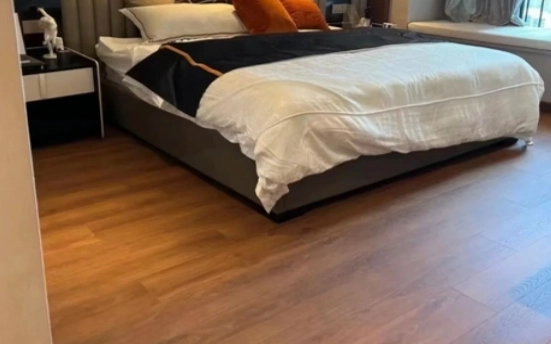
- A continuous wood-look floor in a light oak, warm walnut or slightly grey tone
- A few loose rugs where you want extra softness
- Simple daily care: vacuum, then a damp mop
When the design team picks a small palette of wood designs, they can roll the same concept across many properties and still adapt furniture and textiles for each local market.
Corridors: the toughest test in the building
If anything is going to fail, it will usually fail in the corridor. Wheels follow the same tracks every day, and people rarely lift heavy bags completely off the floor.
For this zone, laminate flooring needs:
- A higher AC rating
- A thicker board for a more solid feel
- A dense HDF core that can handle impact and edge stress
With that combination and the right underlayment, you get a surface that’s easy to clean, doesn’t trap dust like carpet, and still looks sharp after a few busy seasons.
Serviced apartments: living, working, cooking
Serviced apartments are a different animal. Tenants may stay for months, cook daily, drag chairs, and treat the space very much like a home.
Laminate flooring can still work here if you respect a few limits:
- Use boards with good moisture resistance and sealed click joints in kitchen and entrance strips
- Pay attention to detailing around sinks, fridges and dishwashers
- Train cleaning staff to wipe up standing water quickly instead of “leaving it for later”
The upside is a single, continuous floor that visually connects entry, living and sleeping areas, which helps compact units feel more generous.
Meeting rooms, lounges and public zones
Conference rooms, small ballrooms and lounges are good candidates too. Chairs move, tables get rearranged, catering trolleys come and go. A hard surface like laminate:
- Handles chair wheels better than soft carpet
- Works well with area rugs to define different seating zones
- Doesn’t go out of style as fast as some patterned carpets tend to
For boutique or upscale concepts, herringbone or parquet-style laminate gives that “hotel classic” look while still keeping installation and care quite straightforward.
What to Ask Before You Sign Off on Laminate
When you talk to a supplier, a few simple questions will tell you a lot about whether the product really fits hospitality use.
“Which AC classes and thickness do you recommend for each area?”
A one-product-fits-all answer is usually a red flag. Guest rooms, corridors and lobbies behave differently. A good technical team will break down the building into zones and suggest specific combinations using their existing AC and thickness options.
“What kind of core and density are you using?”
Numbers around the higher end of the density range indicate a board that has real weight and resistance to day-to-day knocks. That’s what you want when luggage and trolleys are part of the daily load.
“How broad is your décor and surface range under one system?”
For a group brand, you don’t want to chase ten different materials across regions. Having wood, stone, and patterned options in one laminate system makes life easier for design teams and for procurement.
“Which emission grades and certificates do your boards meet?”
In closed, air-conditioned hotels, indoor air matters. Asking about emission grades like E0, E1 or Carb2 and widely recognized certificates is not paperwork for its own sake; it’s part of looking after guests and staff.
About Lanhe
Lanhe, officially Shandong Lanahe Import and Export Trade Co., Ltd., is based in Jinan, in Shandong Province. The company focuses on decorative flooring products and works as both a producer and an exporter. It operates automated production lines that run from raw material preparation through pressing, profiling, surface finishing, inspection and packaging, under a structured quality management system.
Laminate flooring is one of Lanhe’s main businesses. The range includes several thicknesses and wear classes, together with a wide collection of designs: classic oak, walnut and other wood looks, stone patterns, and special layouts such as herringbone. Different surface treatments are available, from smooth matt to textured and handscraped effects, giving designers enough tools to match very different interior concepts using one technical base.
Lanhe ships its flooring to customers in Europe, North America, Australia, Southeast Asia and other markets, where it is used in homes, offices, hotels and public spaces. The company positions itself as a long-term partner rather than just a one-off supplier, with an emphasis on stable product quality and support for B2B clients.
Conclusion
Laminate flooring isn’t a magic answer for every corner of a hotel or serviced apartment building. But when you treat it as a serious technical material, choose the right class and thickness, and match the design and surface to each zone, it can do a lot of heavy lifting.
Guest rooms get a clean, modern base that’s easy to keep tidy. Corridors gain a hard-wearing surface that stands up to wheels and footsteps. Serviced apartments can look more like real homes without handing the maintenance team a headache.
For groups planning multiple properties or phased renovations, working with a focused supplier like Lanhe makes it easier to repeat a successful flooring concept in city after city, while still adjusting details for each building. In a market where reviews talk about “feel” as much as price, that kind of reliable, repeatable flooring choice is worth thinking about early in the design process.
FAQs
Is laminate flooring really tough enough for hotel corridors?
It can be, if you select laminate with higher wear classes and a solid core. Boards at the upper AC levels and in thicker formats are built to handle repeated rolling loads and heavy foot traffic, which is exactly what corridors see all day.
Won’t laminate flooring be noisy for guests in the room below?
Impact sound depends a lot on installation. Using a suitable underlay and a thicker board helps reduce the sharp “tap” sound some people worry about. When installed properly, laminate can work comfortably within hospitality noise expectations.
Can laminate flooring handle spills from drinks or bathroom moisture?
Laminate is not a waterproof membrane, but modern boards with good water resistance and sealed joints perform well with everyday spills, as long as staff wipe them up within a reasonable time. In wet zones like bathrooms you would still use other finishes, but in bedroom and living zones laminate handles normal use without drama.
How does laminate compare to carpet in maintenance for hotels?
Carpet can feel soft but is harder to keep looking fresh: stains, deep dirt and wear paths appear quickly in busy areas. Laminate flooring is easier to vacuum and mop, doesn’t trap dust and allergens the same way, and usually keeps a more even appearance over several guest cycles.
Why might a hotel group or serviced apartment brand choose Lanhe as a laminate supplier?
Lanhe focuses on laminate and similar flooring products, with automated production, a broad design library and experience shipping to overseas markets. For hospitality buyers, that means they can source different looks and technical levels from a single partner, while keeping documentation, logistics and long-term supply under control.
