

Squeaking laminate flooring under normal foot traffic stands out as a recurring headache in many residential and light commercial projects. The sound originates from friction within the floating assembly—typically where planks shift vertically against each other, grind at locking joints, or flex over subfloor inconsistencies. Field experience shows this almost never points to outright material failure in the planks. Far more commonly, it ties back to base preparation shortcomings, climate-driven movement, or installation tolerances that drifted out of spec. Effective resolution calls for methodical troubleshooting, starting with low-impact surface treatments and scaling up only when necessary. The strongest outcomes come from front-loading prevention through disciplined site prep and careful product matching to site conditions.

Why Does Laminate Flooring Squeak? The Most Common Causes
Noise in laminate develops from relative motion between components that the system intends to keep stable. Floating installations rely on uniform support and controlled expansion to prevent unintended contact points.
Subfloor unevenness leads the pack of issues seen on job sites. Bases exceeding 3mm deviation across a 2-meter span force planks to bridge lows. Load from walking introduces deflection that repeats at joints or edges, wearing tolerances and building audible friction, especially along predictable traffic lines.
Expansion perimeter gaps cut too narrow rank right behind. Industry guidelines specify 8-10mm clearance at walls, transitions, and obstructions. When installers crowd the layout or later trim/baseboard work seals off space, planks bind during normal dimensional response. That restrained movement translates into creaks under shifting weight.
Humidity cycles and temperature shifts hit hard in regions with seasonal extremes. HDF cores react to relative humidity straying from the 40-60% comfort zone, swelling or contracting across planks. Short acclimation periods—under 48-72 hours onsite—or inconsistent indoor control allow uneven response that stresses joints and amplifies rubbing.
Underlayment performance varies widely depending on density and compatibility. Overly compressible foam flattens under sustained traffic, increasing plank travel. Missing vapor barriers on slab pours invite moisture migration, while leftover debris or poor seams create pressure spots that encourage noise.
Trapped particles under the floor—installation dust, grit, or stray fasteners—establish pinpoint fulcrums. Even minor debris forces localized rocking that grinds long edges together with each step.
Joint loosening accumulates from repeated stress on click connections. Tight manufacturing tolerances hold initially, but heavy use or minor alignment errors during assembly permit incremental play. In high-traffic homes, this evolves into noticeable shifting and associated squeaks.
Thicker, softer underlay can backfire by adding bounce rather than damping. While it softens impact initially, excessive give allows dense cores to over-flex if locking profiles lack exceptional grip strength.
Quick Self-Assessment: How Serious Is the Squeaking?
Severity assessment directs the repair path efficiently. Traverse the space deliberately, mapping whether creaks cluster in defined zones—doorways, under cabinets, or specific runs—or distribute evenly. Concentrated noise frequently links to isolated debris or a single flatness deviation. Broad patterns that flare with weather shifts usually trace to humidity response or perimeter binding.
Apply deliberate downward pressure at complaint spots. If the sound quiets under constant load, minor joint movement or flex often responds to surface friction reducers. Track changes after humidity adjustments; louder response during moist conditions reinforces environmental contribution. On fresh installs, probe perimeter clearances with a slim gauge—readings below 5-6mm indicate compression as a factor.
This field check separates cases suited to quick interventions from those requiring base-layer correction.
Step-by-Step Fixes Without Removing the Floor
Many squeaks yield to minimally invasive approaches when identified promptly.
Dry lubricants applied to seams offer the first-line response. Talcum powder, baby powder, or graphite dust introduced into joints around affected areas cuts edge-on-edge friction in milder instances. Distribute by foot traffic, then sweep excess. Relief often persists months, with drier environments prompting occasional reapplication.
Liquid lubricants—silicone sprays or purpose-formulated joint treatments—reach deeper for stubborn moderate cases. Deliver through fine nozzles into accessible gaps, followed by surface cleaning to avoid slick spots. Discreet testing prevents finish issues.
Adhesive injection products engineered for floating systems stabilize evident joint play. Precise application into targeted seams, followed by weighting for 24 hours, bonds connections without surface disruption in localized spots.
Underfloor access in basements or crawlspaces allows efficient shimming. Tapered wedges or added fasteners at noise origins eliminate subfloor deflection from below, preserving the finished surface.
Persistent or expansive noise may demand partial disassembly. Starting at edges, unclick rows, vacuum thoroughly, level subfloor deviations with compound, reinstall underlay, verify expansion zones, and reassemble.
How to Prevent Laminate Floor Squeaking from the Start
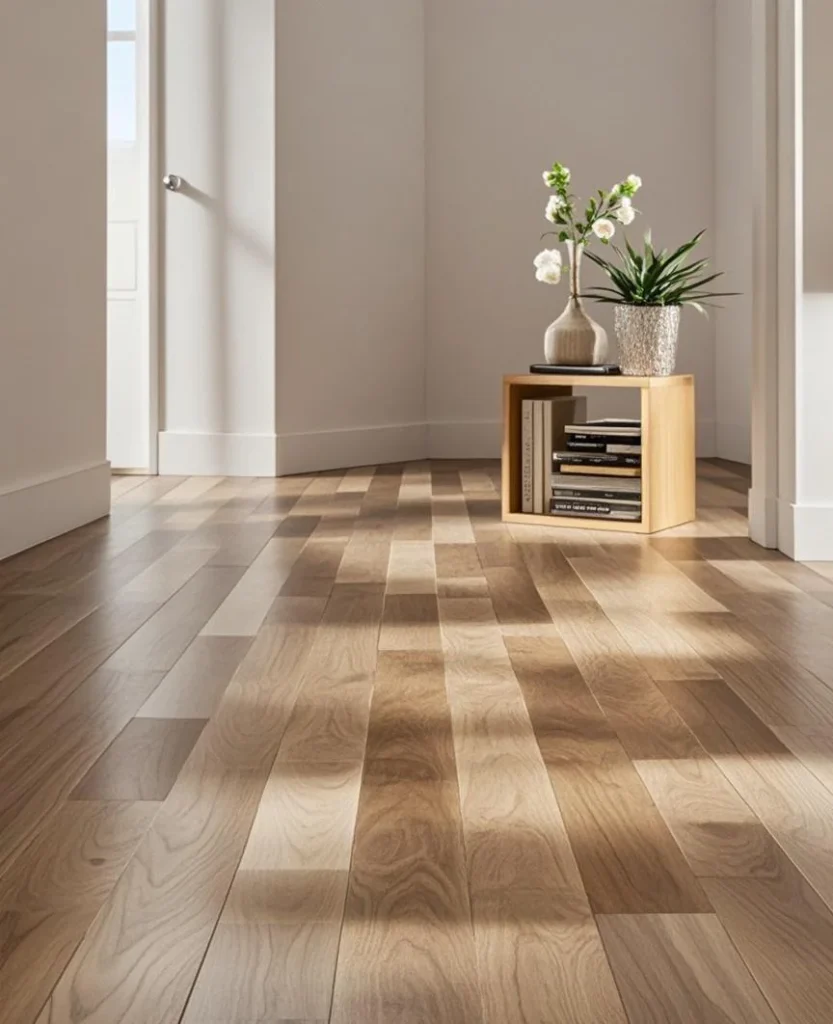
Proactive measures during preparation and layout eliminate most noise potential.
Subfloor flatness verification within 3mm over 2m precedes everything. Corrective grinding, sanding, or self-leveling compounds address deviations, followed by exhaustive vacuuming to eliminate migration risks.
Underlayment specification matches substrate and expected load. 2-3mm products with sufficient density and integrated barriers suit concrete bases particularly well. Higher-density selections bolster HDF core support and curb compression-induced travel.
Full acclimation—48 hours at minimum, 72 recommended—equalizes plank moisture content in the installation space, stacked for circulation.
Expansion gaps of 8-10mm maintained consistently with spacers prevent binding. Layout avoids forcing fits or premature trim interference.
Product characteristics influence long-term quietness. High-density HDF cores deliver dimensional stability superior to lower-density variants. Precision-engineered locking profiles sustain engagement under load, while comprehensive waterproof sealing on edges and surfaces restricts moisture-driven expansion. Across varied export climates—from cold North American heating seasons to humid Southeast Asian conditions—floors built with low expansion rates and consistent tolerances maintain performance reliably.
About Shandong Lanhe Import and Export Co., Ltd.
Shandong Lanhe Import and Export Co., Ltd. manufactures and exports flooring solutions, including laminate lines engineered for durability and installation simplicity. Production runs on automated equipment in Jinan, with quality checks covering raw inputs through to shipment. Laminate products utilize high-density HDF cores for structural rigidity and movement resistance, aluminum oxide wear layers up to AC5 rating for abrasion endurance, and 100% waterproof construction that protects against deformation from spills or ambient humidity. Click-lock mechanisms support glue-free and nail-free placement, while formaldehyde emissions align with E0 standards for indoor air quality. These collections reach markets in North America, Europe, Australia, and additional territories, performing consistently in residential and light commercial environments with realistic surface visuals and dependable stability.
Conclusion
Laminate flooring noise predominantly stems from installation variables, site preparation, or environmental interactions rather than plank defects. Thorough evaluation of subfloor condition, gap provisions, and humidity influence points toward appropriate remedies, frequently confining effort to lubricants or spot stabilization. Timely correction avoids progression, whereas strict adherence to proven protocols and suitable material properties during setup ensures sustained quiet operation across years of service.
Frequently Asked Questions
Why is my new laminate floor squeaking right after installation?
Freshly laid laminate often creaks from incomplete acclimation, overly restricted perimeter gaps, or overlooked debris beneath planks. Provide settling time, introduce talcum powder to seams, or adjust spacing in compressed zones.
How do I fix squeaky laminate flooring without pulling it up?
Begin with dry lubricant—graphite powder or baby powder—worked into joints near noisy sections. For ongoing issues, apply injection adhesive to loose connections and weight down. These steps reduce friction and limit movement in typical situations.
Can humidity changes make my laminate floor start creaking?
Relative humidity swings prompt slight plank expansion or contraction, stressing joints or perimeter contact. Control indoor levels at 40-60% seasonally, and keep expansion clearances free of obstruction.
What underlayment helps prevent laminate floor squeaking?
A 2-3mm underlay with adequate density and moisture barrier characteristics performs best, especially on concrete. Denser formulations support HDF cores more effectively and minimize flex-related noise compared to softer alternatives.
Does waterproof laminate flooring squeak less than regular types?
Sealed waterproof edges and surfaces limit moisture absorption that fuels swelling and joint friction. This stability commonly reduces creak frequency in fluctuating-humidity locations, provided subfloor evenness and gap allowances meet specifications.
