

Laminate floor edge lifting develops when plank perimeters rise or curl upward, typically along baseboards, door casings, or cabinet lines, producing noticeable unevenness or small gaps. Installations in variable climates often reveal this months or years later, particularly in zones subject to occasional moisture or heavy foot traffic. The condition differs markedly from buckling, which arches larger field areas off the subfloor, or peaking, confined to interior joint lines. Edge lifting concentrates at boundary rows or moisture-exposed locations such as entries and kitchens, leaving central sections comparatively level.
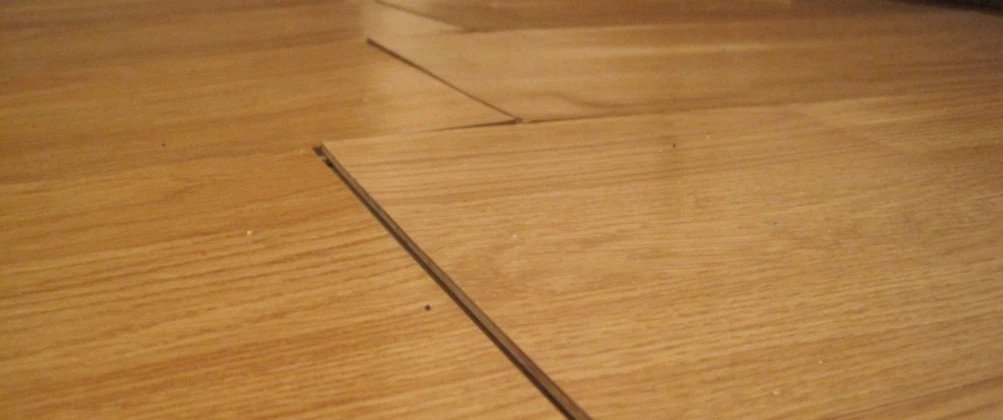
Early recognition of laminate flooring lifting edges guides whether perimeter adjustments resolve the matter or if lock integrity has already suffered. In practice, the majority trace to constrained expansion combined with site-specific or environmental contributors.
What Does It Mean When Laminate Flooring Lifts at the Edges?
Laminate flooring lifting edges indicates perimeter planks detaching partially from the subfloor and curling at outer margins. The result appears as raised lips against walls, thresholds, or fixed cabinetry, occasionally trapping debris or creating minor trip points. Unlike buckling, which elevates broad expanses uniformly, or peaking at laminate seams, edge lift remains localized to boundary zones. Warping or cupping alters individual plank profiles through asymmetric moisture uptake, whereas edge lifting stems primarily from directional pressure outward.
Typical sites include wall-adjacent rows, doorway transitions, and areas near exterior glazing where ambient humidity infiltrates more readily. In Southern California installations, seasonal coastal moisture followed by drier inland conditions frequently accelerates perimeter response.
Is Edge Lifting a Serious Problem or Just Cosmetic?
Edge lifting begins as a visual irregularity—slight curling that disrupts floor continuity and accumulates dust—but seldom confines itself to appearance. Minor instances, rising under 2 mm and flattening temporarily under load, often qualify as superficial when corrected swiftly. Some overlook initial signs, anticipating seasonal contraction to reverse the effect, yet sustained restriction continues stressing click connections.
Significant risk emerges once elevation persists. Repeated cycles fatigue locking profiles, resulting in loosened joints, audible creaking, or progressive separation. In occupied residential spaces or light commercial environments, cumulative traffic exacerbates wear and introduces safety concerns. Moisture-driven cases permit deeper ingress, risking core degradation or concealed mold. Prompt resolution averts escalation; delay frequently converts manageable boundary correction into selective plank replacement.
The 5 Most Common Causes of Laminate Floor Edge Lifting
Lack of Expansion Gap at Walls
Inadequate perimeter clearance leads field reports. Floating laminate accommodates thermal and hygroscopic movement; standards prescribe 8-12 mm margins along walls, jambs, and obstructions. Tight cuts or pinned baseboards block expansion, channeling force to outer rows and causing laminate expansion gap problems that manifest as edge rise.
Moisture or Humidity Exposure
Elevated ambient humidity or spot water contact induces core swelling, pronounced at vulnerable edges. Incidental spills, steam cleaning, or subfloor vapor transmission drive uneven absorption. Sustained relative humidity exceeding 55-60% in moisture under laminate floor scenarios triggers curling, especially near exterior exposures.
Uneven or Soft Subfloor
Subfloor deviations beyond 3 mm in 3 meters establish uneven support. Depressions permit localized settling then rebound, while compressible substrates yield under load. In larger layouts, minor inconsistencies compound, concentrating stress at restrained edges and producing uneven subfloor laminate problems.
Heavy Cabinets or Furniture Restricting Movement
Immobilized heavy elements—kitchen islands, built-in cabinetry, or substantial case goods—anchor sections against float. Expansion then displaces toward free perimeters, lifting edges. Furniture causing laminate floor lifting appears commonly in remodels or furnished commercial spaces where anchors were overlooked.
Locking System Stress or Poor Dimensional Stability
Inconsistent click engagement allows incremental shifts that aggregate into visible lift. Lower-density cores exhibit elevated thickness swelling under humidity, while wider dimensional tolerance variations reduce uniform response. Laminate locking system failure or poor quality laminate expansion becomes evident in climates with pronounced cycles.
How to Fix Laminate Flooring That Is Lifting at the Edges
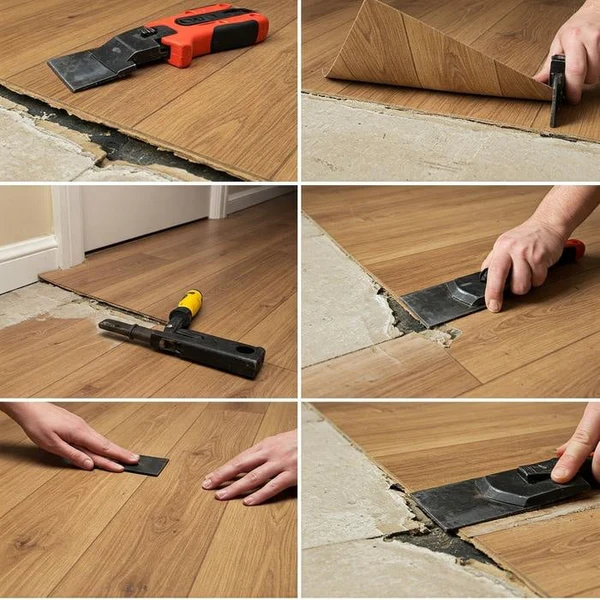
Check and Restore Expansion Gaps
Detach baseboards systematically. Probe clearances with a thin gauge; where deficient, extend edges using an oscillating cutter or guided saw to achieve uniform 8-12 mm relief. Clear residue, apply distributed weight over raised zones for 48-72 hours, then reinstall trim with preserved clearance.
Control Indoor Humidity Levels
Track conditions with a hygrometer, maintaining 35-55% across seasons. Deploy dehumidifiers during humid phases and humidifiers in dry intervals. Restrict wet maintenance to lightly damp methods.
Relieve Pressure Near Fixed Objects
Temporarily relocate heavy pieces. For permanent fixtures, introduce relief beneath toe kicks when practical. Modify thresholds or transitions to permit movement, trimming underlying edges as required.
When You Need to Replace Damaged Planks
Irreversible lock damage or core swelling necessitates targeted replacement. Disassemble from perimeter, document orientation, excise compromised sections, and insert compatible boards. Secure clicks without compromising float.
When Edge Lifting Means the Floor Was Installed Incorrectly
Installation deficiencies frequently underlie recurring laminate flooring lifting edges, distinct from ambient influences. Perimeter overcuts or absent gaps impose immediate constraint, evident sooner in compact rooms where expansion accumulates rapidly. Expansive areas display delayed onset as movement stresses accumulate. Subfloor leveling omissions or improper underlay seams direct pressure outward.
In multi-unit residential or light commercial projects, batch inconsistency or abbreviated acclimation magnifies discrepancies across surface area. Differentiating setup errors from environmental factors informs responsibility—material warranties address production defects, not field execution.
How to Prevent Laminate Floor Edges from Lifting
Proper Acclimation Before Installation
Allow material to stabilize onsite for minimum 48 hours, extending to 72 in variable conditions. Arrange cartons with spacing to promote equilibration.
Leaving Correct Expansion Gaps
Enforce 8-12 mm boundaries around all fixed elements, utilizing spacers for uniformity.
Moisture Control in Different Climates
Maintain consistent indoor humidity through seasonal adjustment. In regions with coastal influence or export destinations subject to humidity swings, routine monitoring mitigates cyclic stress.
Choosing Dimensionally Stable Laminate Flooring
Prioritize high-density HDF cores exhibiting reduced swelling coefficients. Precise locking geometries limit inherent play. Edge-sealed, moisture-resistant treatments and balanced backer construction counteract directional tension. Manufacturing consistency—dimensional verification and performance testing—delivers reliable behavior across diverse climates.
About Shandong Lanhe Import and Export Co., Ltd.
Shandong Lanhe Import and Export Co., Ltd., located in Jinan, maintains fully automated laminate production with integrated quality protocols. Raw material inspection precedes in-line monitoring of dimensional accuracy, locking engagement, surface integrity, and final evaluations for wear, impact, water resistance, and emissions compliance to FloorScore and CE standards. Laminate collections incorporate dense cores, protective edge treatments, durable aluminum oxide wear layers, and tight-tolerance click systems engineered for sustained performance in North American, European, and other export markets.
Conclusion
Laminate floor edge lifting predominantly results from perimeter restriction, moisture influence, or installation particulars that hinder accommodation. Timely gap restoration and environmental management resolve the preponderance of occurrences prior to lock compromise. Dimensionally stable selections featuring robust cores and accurate engineering further diminish susceptibility in residential and commercial contexts. Proactive resolution conserves resources relative to deferred correction or sectional renewal.
FAQs
Why is my laminate floor lifting near the wall?
Lifting near walls usually originates from inadequate expansion allowance or baseboards constraining the perimeter. Humidity-induced swelling meets resistance and forces edges upward. Reestablishing proper clearance typically resolves laminate floor edge lifting in these locations.
Can high humidity cause laminate floor edges to lift?
High humidity swells core material, particularly at exposed margins, resulting in curling or rise. Levels persistently above 55% paired with limited gaps commonly produce the condition. Maintaining 35-55% indoor humidity reduces laminate flooring lifting edges recurrence.
How do you fix laminate flooring lifting at the edges?
Begin with baseboard removal and edge trimming to restore 8-12 mm expansion zones. Apply weight to affected areas for several days. Mitigate humidity sources and release furniture pressure. These measures address most instances of laminate floor lifting without complete replacement.
Will laminate floor lifting go away on its own?
Limited lifting may subside temporarily during contraction phases, yet absent correction of underlying restriction or moisture, progression resumes and often compromises locking integrity over cycles.
Is edge lifting a sign of poor laminate quality?
Edge lifting more frequently derives from installation oversights, subfloor variations, or site conditions than core material defects. Nevertheless, reduced density or imprecise locking profiles heighten vulnerability in humid environments—higher-density, tightly toleranced options demonstrate greater consistency.
