

Laminate flooring installation mistakes drive the bulk of performance complaints in the field, surpassing actual material defects in frequency. Field observations show that setup errors disrupt the floating system’s balance, over-stressing the interlocking profile and leading to issues like buckling, joint separation, or creaking down the line. The click-lock design depends on accurate tongue-and-groove engagement to spread loads and permit slight thermal movement; when installation constrains that, localized pressure builds until failures appear. In larger residential layouts or light commercial spaces, these problems scale quickly—cumulative expansion over extended runs turns small deviations into noticeable laminate floor failure after installation or problems caused by bad laminate installation.
Grasping the underlying mechanics of these errors allows better anticipation and mitigation, particularly where project scale demands consistent execution.

Why Installation Mistakes Cause Most Laminate Floor Failures
Laminate operates as a floating assembly that must expand and contract freely with environmental changes. The HDF core responds to humidity and temperature shifts; locks transfer forces plank-to-plank. Setup restrictions channel that movement into damaging stress at connections or edges. Expansive areas—beyond typical 30-40 linear feet—accumulate greater displacement, heightening risk in multi-room residential or office settings where uniformity across batches and site prep proves critical.
Skipping Proper Floor Acclimation
What Happens If You Don’t Acclimate Laminate Flooring
Material arriving from cooler storage or different humidity levels starts undersized relative to the room. Once laid, it takes on ambient moisture, expanding more than anticipated. This differential movement often surfaces as laminate acclimation mistake effects—buckling waves, perimeter lift, or end-joint gaps—within the first humidity cycle.
How to Properly Acclimate Laminate Flooring
Position sealed cartons in the installation area for a minimum of 48 hours, preferably 72 in climates with noticeable swings. Stack with spacing for circulation on all faces. Keep room conditions at 65-75°F and 35-55% relative humidity to let the core stabilize evenly.
Not Leaving Enough Expansion Gaps
Why Expansion Gaps Are Critical
Perimeter clearance absorbs natural dimensional changes. Absent or insufficient space, expansion pushes against fixed boundaries, forcing upward or lateral displacement—classic laminate flooring expansion gap problem resulting in laminate floor buckling wall or edge rise.
How Wide Should Laminate Expansion Gaps Be
Maintain 8-12 mm along walls, door frames, pipes, and cabinet bases. Employ spacers throughout layout to hold uniformity. In higher-humidity zones, favor the wider end to accommodate greater swell potential.
Installing Over an Uneven Subfloor
How Uneven Subfloors Damage Locking Systems
Irregular surfaces create fulcrums where planks pivot or bind under load. Continuous traffic fatigues the lock profile, generating laminate floor clicking noise or progressive loosening at joints.
Subfloor Flatness Standards for Laminate
Limit deviation to no more than 3/16 inch over 10 feet or 1/8 inch over 6 feet. Use a long straightedge for verification; correct lows with self-leveling underlayment. Resolving uneven subfloor laminate problems at the outset averts cascading stress.
Choosing the Wrong Underlayment
How Underlayment Affects Floor Stability
Underlayment dampens impact, mitigates sound transmission, and offers basic vapor control. Inadequate thickness or type transmits subfloor flaws upward, increasing lock strain. Overly rigid options fail to cushion minor imperfections.
Signs of Poor Underlayment Choice
Audible creaking, telegraphing of subfloor texture, or accelerated joint wear signal mismatch. Select 2-3 mm foam or cork with vapor retarder for slab applications. Wrong underlayment laminate problems commonly emerge as instability in traffic-heavy areas.
Installing Laminate in Wet Areas Without Protection
Moisture Risks in Kitchens and Entryways
Incidental spills, frequent mopping, or tracked water seep into edges, swelling the core and risking delamination. Conventional laminate tolerates limited exposure but repeated contact overwhelms it.
How to Protect Laminate from Moisture
Seal cut edges in splash-prone zones or choose enhanced moisture-resistant variants. Lay vapor barrier film over concrete slabs. Reserve laminate for dry zones; tile or resilient products suit wetter locations. Laminate water damage installation mistake often appears in unprotected high-risk rooms.
Locking Planks Too Tightly or Forcing Joints
How Locking System Stress Causes Future Failure
Excessive force during connection misaligns components, compromising engagement strength. Subsequent load cycles exploit the weakness, leading to separation or audible movement. Manufacturing precision in lock geometry and tolerances reduces inherent play; forced assembly accelerates degradation.
Correct Way to Connect Laminate Planks
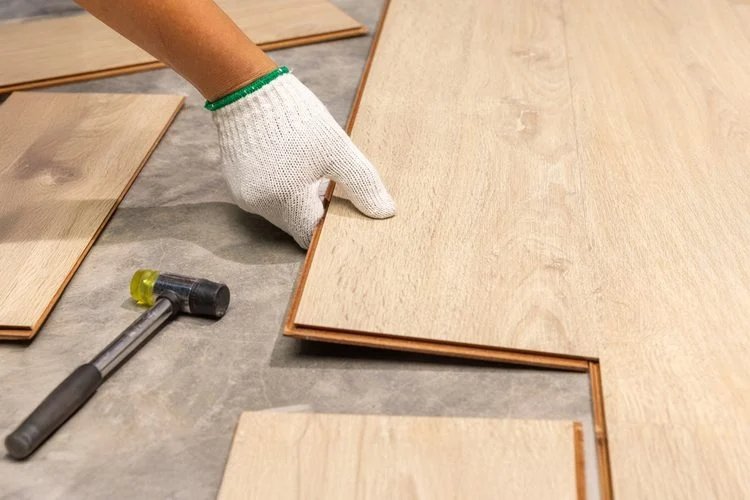
Align the tongue with the groove, angle slightly, and lower until the click engages. Use a tapping block for gentle seating—avoid direct hammer strikes. Proper technique preserves lock integrity for movable, secure joints.
Ignoring Room Size Limits Without Transition Breaks
Why Large Areas Need Expansion Breaks
Uninterrupted spans exceed practical movement limits, concentrating expansion and causing large room laminate buckling or field tenting.
Maximum Installation Size for Laminate Flooring
Restrict continuous areas to roughly 30 ft x 30 ft or 1000 sq ft maximum. Incorporate T-moldings or reducers at thresholds and mid-runs. Laminate floor transition strip purpose centers on permitting sectional independence.
Installing Cabinets or Islands on Top of Floating Floors
Why Floating Floors Must Move Freely
Pinned heavy fixtures block expansion paths, redirecting force to free edges and inducing lift or buckling.
Correct Installation Order for Kitchens
Place cabinets prior to flooring, leaving clearance around bases. For islands, maintain gaps or use floating trim. Sequence preserves float in anchored zones.
Failing to Stagger End Joints Properly
Why Joint Staggering Improves Stability
Aligned end joints form continuous weak planes susceptible to separation under shear.
Minimum Stagger Distance for Laminate
Offset joints by at least 6-12 inches randomly, avoiding H configurations. Proper staggering distributes forces evenly across the field.
Skipping Manufacturer Installation Guidelines
How Installation Errors Void Warranty
Non-adherence to specified procedures—acclimation, gaps, subfloor prep—typically excludes coverage for resulting issues.
Why Product Specs Matter in Installation
Instructions align with core density, lock precision, wear layer durability, and dimensional tolerance. Higher-density HDF and tightly controlled clicks provide greater margin for site variations in fluctuating export climates.
How to Tell If Laminate Flooring Was Installed Incorrectly
Indicators of bad laminate installation encompass perimeter buckling, footfall creaking, joint gaps, or edge elevation near boundaries. Examine stagger patterns, probe perimeter clearances, and tap for hollow spots. Movement or noise under walking suggests loose engagement or subfloor disconnect. In broader projects, inconsistent settling between areas points to prep inconsistencies.
How to Fix Problems Caused by Installation Mistakes
Perimeter gaps often improve with baseboard removal, edge trimming for clearance, and weighting to settle planks. Buckling responds to transition relief and humidity stabilization. Clicking may subside after underlay correction or subfloor leveling. Extensive lock compromise requires row-by-row disassembly, subfloor remediation, and re-lay. Fix laminate floor after bad install usually prioritizes boundary adjustments; widespread damage may necessitate selective or complete renewal.
How to Avoid These Mistakes in Future Projects
Adopt a methodical sequence: confirm subfloor levelness and dryness, acclimate stock, incorporate planned gaps and transitions, match underlayment, and follow product directives strictly. Materials with stable cores, accurate lock profiles, and robust wear layers tolerate minor deviations better. Commercial-scale work benefits from standardized checklists and batch uniformity, contrasting with residential flexibility.
About Shandong Lanhe Import and Export Co., Ltd.
Shandong Lanhe Import and Export Co., Ltd., headquartered in Jinan, runs fully automated laminate production lines with layered quality oversight. Protocols include raw material lab sampling, in-line checks for dimensions, locking function, and surface quality, plus finished evaluations for wear resistance, impact, water resistance, and VOC levels compliant with FloorScore and CE. Laminate incorporates high-density cores, moisture-resistant balance layers, aluminum oxide wear surfaces, and precise click mechanisms designed for reliable performance in North American, European, and other export regions.
Conclusion
Laminate flooring installation mistakes—from omitted acclimation to constrained gaps—underlie most operational failures by impeding intended movement and overloading locks. Spotting early signs such as buckling or noise enables corrective steps that preserve the installation. Emphasis on preparation, guideline adherence, and dimensionally stable products lowers vulnerability across residential and larger applications. Disciplined execution yields durable, level surfaces with minimal long-term issues.
FAQs
What is the most common laminate flooring installation mistake?
Skipping acclimation tops the list—unadjusted planks expand unevenly in the room, leading to buckling or gaps over time.
How do you fix laminate flooring installed without expansion gaps?
Detach baseboards, trim edges to establish 8-12 mm clearance, remove debris, and apply weight for days to release built-up pressure.
Can bad installation cause laminate floor buckling?
Restricted gaps, uneven subfloors, or forced joints frequently result in buckling since expansion lacks proper outlets.
Do installation mistakes void laminate flooring warranty?
Warranties generally exclude issues from improper acclimation, gaps, or subfloor preparation—compliance with guidelines preserves coverage.
How flat does a subfloor need to be for laminate flooring?
Deviation should stay under 3/16 inch over 10 feet or 1/8 inch over 6 feet to avoid uneven load on locks and maintain contact.
