

By 2026, eco-friendly SPC flooring and sustainable laminate options sit at the center of most commercial specifications and development bids. Stricter indoor air quality rules, formaldehyde restrictions, and green certification demands push the change forward. These resilient flooring categories provide dependable field performance while meeting low-VOC requirements and verified low-emission construction standards.
The sections ahead lay out the primary market drivers, material-to-material comparisons, certification specifics, on-site applications in LEED-targeted builds, and grounded cost assessments. The intent stays direct: supply B2B purchasers with practical details to select products that pass regulatory checks and deliver consistent returns through the installation lifecycle.

Why Sustainable Flooring Matters in 2026
Flooring choices in commercial spaces have grown far more selective. Indoor environmental quality regulations carry real weight, and end-clients now demand traceable sustainability records. Office, hospitality, retail, and healthcare installations prioritize low-emission materials to limit volatile organic compound buildup for improved daily occupancy.
Market patterns lean toward warmer neutral palettes, genuine-feeling surfaces, and tough resilient constructions that cut down on frequent renewals. Recent industry tracking shows resilient segments expanding because of reliable waterproofing and extended replacement intervals. Projects pursuing LEED credits give preference to flooring that adds value in indoor air quality or materials and resources categories.
Operational gains build steadily. Products engineered for heavy use, incidental spills, and routine cleaning reduce ongoing upkeep expenses and limit operational pauses. Submissions reinforced with independent emission documentation tend to progress in tenders, particularly for North American and European contracts that enforce clear compliance lines.
SPC vs Laminate: Eco-Friendly Comparison
Placing SPC next to laminate reveals sharp contrasts in environmental makeup and day-to-day behavior.
SPC flooring depends on a dense core built from limestone powder fused with stabilizers and polymers. The mineral-dominant base creates high stability and total waterproofing, holding form even after prolonged liquid exposure. Current production recipes stress low-VOC components, consistently clearing full-spectrum emission evaluations when manufacturing controls remain tight.
Laminate flooring centers on a high-density fiberboard core pressed from wood fibers with resins, overlaid by a printed decorative film and sealed with an aluminum oxide or melamine wear layer. Upgraded bonding agents now deliver E0 or E1 formaldehyde emission ratings, cutting release from the wood-composite foundation. Moisture handling has improved markedly, yet laminate still aligns best with environments where humidity stays moderate.
Several factors separate the two clearly:
Core structure shapes raw material origins and disposal paths—SPC draws primarily from mineral sources with opportunities for recycled inclusion, while laminate pulls from renewable wood fibers but relies on precise resin chemistry for emission management.
Emission behavior ties to testing breadth. SPC collections regularly earn FloorScore certification across various volatile compounds, formaldehyde included. Laminate satisfies narrow low-formaldehyde goals through E0/E1 classifications, and certain ranges extend coverage to additional VOC measures.
Wet or variable-humidity zones strongly prefer SPC, which blocks swelling and mold risks from pooled water. Laminate maintains integrity in balanced settings but demands site-specific precautions to avoid problems.
Projected durability runs 15–30 years for each under standard commercial conditions, though SPC’s solid construction commonly resists dents and impacts more effectively.
LEED compatibility stems from low emissions, prolonged service that curbs material turnover, and points available for certified responsible sourcing.
Application context typically settles the decision. Moisture-exposed heavy-traffic zones default to SPC, whereas budget-focused dry interiors turn to laminate for its visual richness and inherent sound absorption.
Essential Certifications for Green Projects
Third-party certifications form the backbone for confirming emission levels and environmental claims. Purchasers need to obtain fresh certificates and validate them through the issuing authority’s records.
FloorScore acts as the leading benchmark for hard-surface flooring. It assesses 35 designated volatile organic compounds in controlled chamber conditions, conforming to California public health methods and contributing to LEED, WELL, and related program credits. The standard holds particular relevance in occupied commercial interiors where air quality impacts routine function.
GREENGUARD Gold maintains tighter thresholds, fitting applications in schools or medical settings, though it aligns closely with FloorScore in flooring evaluations.
E0 and E1 designations zero in on formaldehyde from wood-based composites in laminate. E0 reflects the minimal measurable output, usually well under 0.05 ppm, fulfilling wide-ranging low-emission expectations.
Complementary indicators encompass CE for European market acceptance, ISO 14001 for overarching environmental practices, and external audits from SGS. Validation requires confirming certificate dates and linking to exact product identifiers.
Lanhe Flooring SPC lines feature FloorScore and CE certifications, underpinned by VOC emission testing that matches international environmental guidelines. Laminate products attain E0 and E1 ratings, furnishing documented low-formaldehyde compliance for controlled specifications.
Applying SPC & Laminate in LEED Projects
LEED structures assign credits to materials that enhance sustainability within materials and resources alongside indoor environmental quality domains. Certified SPC and laminate contribute via low emissions, extended wear that limits resource demand, and methods that reduce installation waste.
Office retrofits commonly install SPC across open layouts with persistent traffic and sporadic moisture. The flooring’s tolerance for subfloor variations accelerates scheduling and curbs debris generation. Laminate suits enclosed offices or presentation areas, supplying authentic wood effects enhanced by acoustic underlayment layers.
Hospitality hallways and reception spaces count on SPC for swift recovery from carried-in water or sanitizers. Laminate outfits guest quarters, striking a balance between refined appearance and contained expenditure.
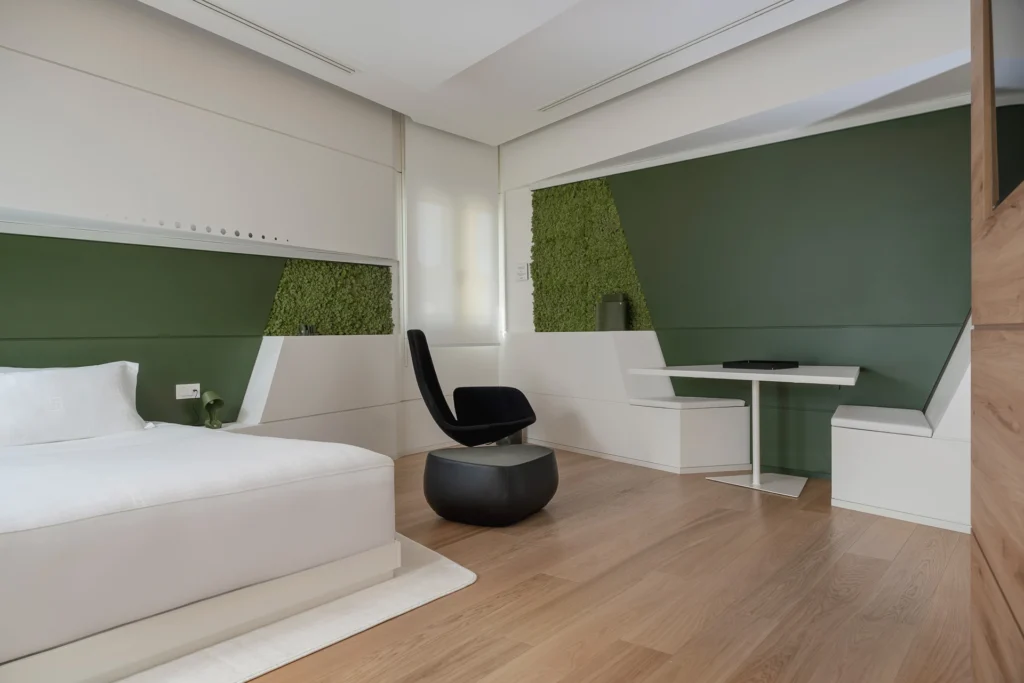
Retail and institutional environments utilize both for resilience. SPC withstands rolling loads and aggressive cleaning schedules, while laminate facilitates incremental refreshes via straightforward panel changes.
Proven low-VOC characteristics support EQ credits by evidencing sustained air quality following placement. Comprehensive airflow during and after installation compresses off-gassing duration to align with verification schedules.
Cost-Benefit Analysis: Sustainable Doesn’t Mean Expensive
Eco-friendly SPC generally lists at a moderate-to-elevated starting price relative to standard laminate, owing to the specialized core and enhanced stabilizers. Lifecycle reviews, however, often reverse the initial impression.
SPC interlocking profiles permit fast deployment over irregular bases, decreasing labor commitments. Waterproof properties eliminate moisture-damage remediation costs in commercial premises. Anticipated 20–30 year spans restrict renewal frequency.
Laminate supplies reduced entry pricing, notably in interior dry zones. E0/E1 formulations produce equivalent endurance where humidity control holds. Factory-direct bulk procurement trims per-unit figures substantially.
In a representative commercial footprint, SPC compensates for added material investment with 30–40% cuts in maintenance and replacement across 15 years. Laminate tightens the margin in lower-exposure areas through baseline economy and straightforward care.
Direct manufacturer ties enable volume scaling, custom configurations, and optimized transport, preserving financial and delivery parameters.
About Shandong Lanhe Import and Export Co., Ltd.
Shandong Lanhe Import and Export Co., Ltd. bases operations in Jinan, concentrating on SPC and laminate flooring manufacture plus international distribution. Automated production sequences oversee the complete workflow from raw input to packaged output, maintaining uniform quality checks at every point.
SPC development stresses eco-friendly blends supported by FloorScore certification and low VOC emission adherence. Laminate reaches E0 and E1 formaldehyde standards, merging longevity, diverse aesthetics, and environmental protection. The lineup features variable thicknesses, high wear classifications up to AC5, and realistic visuals designed for commercial settings.
Distribution covers North America, Europe, Australia, Southeast Asia, and additional territories, reinforced by OEM/ODM adaptability, steady lead times, and full technical paperwork including emission and performance reports. Testing regimes evaluate emissions, abrasion, impact, and water exposure, affirming dependable and environmentally oriented outcomes.
Conclusion
Eco-friendly SPC flooring and sustainable laminate options address 2026 priorities for strength, regulatory alignment, and fiscal prudence in commercial deployments. Concentrating on certified low-emission selections, dissecting certification coverage, and conducting even-handed evaluations facilitate choices that satisfy compliance obligations, client criteria, and enduring project performance.
FAQs
What makes FloorScore certification important for eco-friendly SPC flooring in commercial projects?
FloorScore validates restrained emissions over a wide volatile organic compound range through accredited chamber analysis, conforming to standards such as California Section 01350. It facilitates LEED indoor air quality contributions and builds trust in high-traffic occupied environments where air quality remains essential.
How do E0 and E1 standards apply to sustainable laminate flooring?
E0 and E1 classifications gauge formaldehyde output from laminate core materials, with E0 delivering the lowest readings for stronger environmental fit. These levels uphold global low-emission benchmarks and strengthen green building submissions when integrated with comprehensive VOC assessment.
Is eco-friendly SPC flooring better than laminate for high-humidity commercial areas?
SPC’s limestone-reinforced rigid core guarantees full waterproofing and dimensional hold in humid conditions, diminishing swelling or mold hazards. Laminate equipped with low-VOC and E0/E1 compliance copes with moderate moisture levels but thrives under managed conditions for peak reliability.
What should buyers verify when evaluating low-VOC flooring for LEED certification?
Secure recent FloorScore or equivalent documentation, formaldehyde emission records (E0/E1 for laminate), and external VOC test summaries. Align wear class with projected traffic intensity and examine placement instructions to preserve air quality results post-installation.
Why do commercial projects increasingly specify certified eco-friendly SPC or laminate in 2026?
Certified materials mitigate emission-associated health exposures, unlock green building credit opportunities, and extend operational life via superior build quality. In bid competitions, substantiated sustainability elevates submissions and matches client requirements for responsible sourcing decisions.
